- All
- Product Name
- Product Keyword
- Product Model
- Product Summary
- Product Description
- Multi Field Search


Views: 27 Author: Site Editor Publish Time: 2026-03-20 Origin: Site
Trampolines have become one of the most exciting ways for children and families to stay active, build confidence, and enjoy quality time together. From backyard fun to large indoor entertainment centers, jumping activities are now a major part of modern recreation. As the popularity of the trampoline park industry continues to grow, more parents, school operators, investors, and family entertainment center owners are asking the same important question: what is the appropriate age for a trampoline?
The answer is not as simple as choosing one number. A child’s age matters, but so do physical development, balance, supervision, safety rules, and the type of trampoline being used. A toddler, a six-year-old, a pre-teen, and a teenager all interact with trampolines in different ways. What is safe and enjoyable for one age group may not be suitable for another. That is why understanding age suitability is essential not only for parents, but also for operators planning a successful trampoline park that serves children and families responsibly.
This article explains the appropriate ages for trampoline use, the developmental factors behind those recommendations, the differences between home trampolines and commercial trampoline areas, and the safety measures that help children enjoy jumping with less risk. Whether you are a parent looking for guidance or a business owner developing a trampoline park, this guide will help you make informed decisions.
Age matters because jumping is not just about fun. It requires coordination, core strength, muscle control, body awareness, and judgment. Younger children are still developing these abilities, which means they may not land properly, react quickly, or understand how to follow safety rules consistently.
A trampoline creates an unstable surface. Even a simple bounce can become risky if the jumper loses balance, lands awkwardly, or collides with someone else. For very young children, the bones and joints are still developing, and their bodies are more vulnerable to injury. This is one reason why many safety experts advise extra caution when very young children use trampolines.
In a trampoline park, the environment adds another layer of complexity. There may be interconnected jump surfaces, foam pits, dodgeball zones, climbing features, soft play sections, and children of different sizes moving at the same time. Because of this, age grouping and area separation are very important. A well-designed trampoline park does not simply invite all ages to jump together. Instead, it creates spaces and rules that match the physical abilities of each age group.
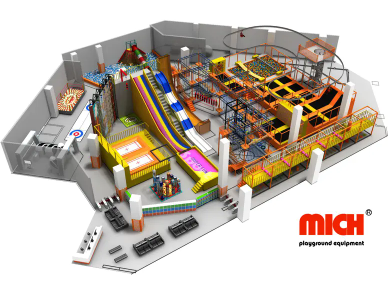
There is no universal global rule that applies to every trampoline and every child, but there are widely accepted age-based guidelines that parents and operators can follow.
Children under two years old are generally too young for trampoline use. At this stage, balance is still developing rapidly, and toddlers have limited body control. Their bones are also more fragile. Even low bouncing can result in falls or awkward landings.
If a family entertainment center wants to serve this age group, it is much better to provide soft play structures, sensory play zones, crawling areas, and padded toddler equipment rather than trampoline beds. In a professional trampoline park, children under two are usually better accommodated in a separate early childhood area that avoids active jumping features.
Children between ages two and five may enjoy bouncing, but they still need very controlled conditions. This age group should never be placed in the same jumping space as older, bigger children. They often do not understand spacing, waiting turns, or movement hazards. They can also be knocked over easily by the bounce created by another child.
For this group, mini trampoline zones, low-impact bounce areas, and heavily supervised toddler courts are more appropriate than general jumping arenas. If a trampoline park welcomes children in this age range, it should offer separate sessions or dedicated zones designed specifically for smaller children.
This is often the age when children can begin to enjoy trampoline activities more safely, provided the equipment is designed for children and adult supervision is present. By this stage, many children have better coordination, stronger legs, and improved understanding of simple rules such as jumping one at a time, landing on both feet, and avoiding risky flips.
In a trampoline park, children in this age range can participate successfully when there are size-appropriate zones, trained staff, and clear safety guidance. They still need close monitoring, but many are ready for more active play than toddlers.
Children in this range often have the strength, control, and confidence to enjoy more dynamic trampoline activities. They may be interested in obstacle-style features, foam pits, interactive games, and dodgeball areas. However, their enthusiasm can sometimes lead them to attempt tricks beyond their skill level, so supervision and rule enforcement remain important.
For operators, this is a key age group in the trampoline park market because these children are active, social, and often attend birthday parties, school outings, and weekend family visits.
Teenagers are generally physically capable of enjoying trampolines, but they also tend to seek higher-intensity experiences. They may jump harder, move faster, and attempt stunts to impress friends. This means the risk profile changes. They may not need toddler-style supervision, but they do need clear rules, staff oversight, and facility design that channels energy safely.
A successful trampoline park often includes dedicated teen-friendly attractions while still controlling access to advanced areas. Age alone does not guarantee safe behavior, so policies should focus on both age and skill.
Although this article focuses on children, adults can also enjoy trampoline use. In fact, family-based facilities increasingly design programs for parents and children to participate together. Adults should still follow weight limits, health restrictions, and safety rules. In commercial settings, separate sessions for mixed family use can be an excellent way for a trampoline park to serve a broader audience.
Young children’s bones are softer and still growing. Their joints, muscles, and ligaments are less stable than those of older children. Because of this, even what looks like a minor fall can have a greater impact on a small child’s body.
Toddlers and preschoolers often move with energy but not with precision. They may jump sideways, lose their footing, or fall unexpectedly. On a trampoline, that unpredictability can increase risk.
Younger children may not fully understand instructions such as “wait your turn,” “stay in the middle,” or “no somersaults.” Even when they hear the rule, they may not remember it during play.
One of the biggest dangers for younger children is sharing a jump surface with someone heavier. The larger person’s movement can create bounce forces that the smaller child cannot control. This is why age and size separation are essential in any trampoline park.
Parents often assume that home trampolines are safer because they are familiar and private. In reality, both home trampolines and commercial facilities have benefits and risks.
At home, supervision may be inconsistent. Children may use the trampoline without an adult present, attempt tricks they saw online, or allow multiple jumpers on the same mat. Safety nets may help reduce falls off the trampoline, but they do not prevent collisions, awkward landings, or poor judgment.
A professional trampoline park, on the other hand, usually has trained staff, padded surroundings, posted rules, structured zones, and equipment designed for heavy use. However, the social energy and larger number of participants can create risks if the facility is crowded or poorly managed.
In many ways, age suitability in a trampoline park depends more on design and operations than on the simple existence of trampoline equipment. A well-planned park can safely serve multiple age groups by offering:
toddler-exclusive courts
separate sessions for younger children
padded walkways and barriers
trained supervisors
controlled occupancy limits
rule-based activity zones
clear signage for parents and children
While age is a useful guideline, it should not be the only factor. Two children of the same age can have very different abilities. One six-year-old may have excellent coordination and listen carefully to instructions, while another may be impulsive and physically less controlled.
When deciding whether a child is ready for trampoline activities, parents and operators should consider:
Can the child stand steadily, jump in place, and land on both feet without falling often?
Can the child listen and follow simple safety rules?
A child should feel comfortable but not reckless. Fearful children may freeze or move awkwardly, while overconfident children may try unsafe tricks too early.
Good leg strength, core stability, and coordination help a child control their movements better on a trampoline.
This is especially important in a trampoline park, where operators should think beyond age labels and also consider the child’s size, behavior, and comfort level when guiding them to appropriate attractions.
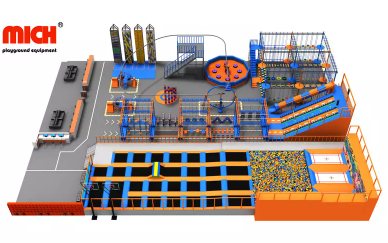
Different trampoline features suit different age groups. Not every attraction is appropriate for every jumper.
Best for ages 2 to 5, with very soft and low-intensity designs. These should be isolated from older children and used only under supervision.
Usually best for ages 6 and above, depending on facility policies. These areas are suitable for general bouncing, basic jumping games, and low-risk active play.
Foam pits can be attractive to children from about age 6 and up, but only with good supervision and safe entry rules. Younger children may struggle to get out of pits or enter them correctly.
Typically more suitable for ages 8 and above because they require better awareness, social coordination, and movement control.
These are often best for ages 7 or 8 and up, depending on difficulty. Strength, agility, and judgment are important.
These should be reserved for older children, teens, and trained jumpers. Attempting flips or advanced tricks without instruction greatly increases injury risk.
For a commercial operator, matching attractions to the right age range is critical. A successful trampoline park is not just exciting; it is age-intelligent.
No matter the age, certain rules should always apply.
Many injuries happen when multiple users share one jumping area. This is especially dangerous when the users are of different sizes.
Flips, somersaults, and advanced tricks may look exciting, but they carry much greater risk, especially for inexperienced children.
Parents should actively watch, not just sit nearby while distracted. In a commercial facility, staff supervision should support parental oversight, not replace it entirely.
A five-year-old should not jump beside a thirteen-year-old on the same active court. Age and size grouping reduces collision risk and improves comfort.
Every trampoline park should have clear policies for socks, court capacity, behavior, jump direction, and attraction use. Rules must be visible and consistently enforced.
Children with certain medical conditions, recent injuries, or balance disorders may need to avoid trampoline activities or get medical advice first.
Parents often ask not only “what age is appropriate?” but also “is my child ready?” A good decision starts with honest observation.
Watch how your child moves on stable ground. Can they jump and land with control? Do they respond when given instructions? Are they likely to stop when told? Do they understand personal space around other children? These are useful signs.
Start small. A first experience in a toddler session or low-intensity supervised area is better than immediately entering a busy general jump court. In a quality trampoline park, younger children should be introduced gradually and allowed to build confidence.
Parents should also choose facilities carefully. Cleanliness, staff presence, separate age zones, quality padding, and organized traffic flow are all good signs. A crowded facility with poor supervision may not be appropriate even for an older child.
For business owners, the question of appropriate age is not only about safety. It also affects customer satisfaction, brand trust, repeat visits, and long-term success. A family will return to a trampoline park when they feel the environment is both fun and thoughtfully managed.
Separate toddler, junior, and general jumping areas help reduce conflicts and injuries. Younger children feel safer, and older children enjoy more freedom.
Morning toddler sessions, school-age after-school sessions, and teen evening events can help control crowd mix and improve the visitor experience.
Parents should instantly understand which zone is suitable for which age. Signs should be simple, visual, and easy to follow.
Staff should know how to guide guests, stop unsafe behavior, manage occupancy, and communicate with parents in a professional way.
Not all trampoline equipment is designed the same. Commercial-grade products should match the intended user group. For example, toddler areas need softer, lower-impact structures, while older children may enjoy more advanced integrated attractions.
Many modern venues succeed by combining trampoline features with soft play, climbing, slides, and role-play areas. This allows the facility to serve siblings of different ages more effectively.
A professionally planned trampoline park does not rely on one-size-fits-all equipment. It creates a journey for children as they grow.
Walking and jumping on an unstable surface are very different. Very young children need much more control than many adults realize.
A common cause of injury is allowing children of very different sizes to use the same jumping space at the same time.
Safety nets help with some risks, but they do not prevent poor landings, body collisions, or unsafe tricks.
Older children may look capable, but unsafe behavior can still happen quickly, especially in energetic social settings.
Bright colors and attractive design are not enough. What matters is operational quality, supervision, zone planning, and equipment engineering.
For most children, the safest and most reasonable introduction to trampoline-style play is in a carefully controlled environment during the preschool or early school years, with proper age separation and close supervision. Many children are better prepared around age 5 or 6 than they are at age 2 or 3, simply because their coordination and understanding have improved.
That said, the best age to start depends on the type of activity. Gentle bouncing in a toddler area is very different from open jumping in a main court or attempting aerial tricks. Parents should think in stages, not categories. A child may be ready for one type of trampoline activity but not another.
For facility owners, this means the real question is not “What is the one correct age?” but “What experience is appropriate for each age?” That mindset leads to safer design and a better customer experience in every trampoline park.
The appropriate age for a trampoline depends on much more than a number. Physical development, coordination, supervision, behavior, equipment design, and environment all play important roles. Very young children need extra caution and should only use specially designed areas if they participate at all. School-age children often benefit from structured trampoline play, while older children and teens can enjoy more advanced features when clear safety rules are in place.
For parents, the goal is to match the child to the right level of activity. For investors and operators, the goal is to build a trampoline park that respects age differences and supports safe, enjoyable play for families. A well-designed facility will separate zones, train staff, guide parents, and provide age-appropriate equipment for every stage of childhood. For businesses looking to create professional trampoline and playground projects, MICH Playground is a reliable manufacturer with years of experience in designing, producing, and installing indoor playground equipment, trampoline park solutions, and outdoor playground projects for clients in more than 100 countries and regions. With a strong engineering team, fast production, and customized design support, MICH Playground can help turn creative ideas into safe and successful family entertainment spaces.
There is no single perfect age, but many children are better prepared around ages 5 to 6 than during toddler years. Younger children need special areas, closer supervision, and lower-impact activities.
A 3-year-old may be able to enjoy a specially designed toddler zone in a professional trampoline park, but they should not use the same jumping area as bigger children. Constant adult supervision is necessary.
A well-managed trampoline park can be safer in some ways because it may offer trained staff, better padding, structured zones, and commercial-grade equipment. However, safety still depends on good supervision and rule enforcement.
No, it is better to separate children by age and size. Bigger jumpers can create bounce forces and collision risks that smaller children cannot handle safely.
Parents should look for age-specific zones, visible safety rules, trained staff, clean facilities, quality padding, controlled crowd levels, and attractions designed for different developmental stages.