- All
- Product Name
- Product Keyword
- Product Model
- Product Summary
- Product Description
- Multi Field Search

Views: 0 Author: Site Editor Publish Time: 2026-10-02 Origin: Site
Municipalities, HOAs, and facility managers face a recurring challenge: designing public spaces that deliver measurable community value without alienating specific demographics. Installing single-demographic fitness zones often results in underutilization and poor return on investment. Conversely, mixing age groups without strategic planning introduces liability risks, safety hazards, and accelerated equipment wear. Addressing multi-generational needs requires a structured approach to procurement. This guide breaks down how to evaluate, customize, and zone Outdoor Fitness Equipment and Commercial Playground Equipment to safely serve youth, adults, and seniors within a unified footprint.
Establishing baseline metrics for a successful installation requires looking past simple foot traffic. You must measure daily user volume across specific times of day, demographic spread during peak hours, and the measurable reduction in vandalism or loitering. Consolidating youth play areas and adult fitness zones reduces overall site preparation, surfacing, and maintenance costs. When you excavate and pour concrete footers for a combined site, you mobilize heavy machinery once. You lay sub-base drainage systems once. This consolidation creates a strong return on investment through inclusive, highly efficient site engineering.
Purchasing static, non-adjustable equipment creates an operational trap. A fixed-height pull-up bar or a static sit-up bench fails to provide adequate stimulus for active adults seeking progressive overload, while remaining entirely inaccessible or too challenging for seniors with limited mobility. Facilitating structured group activities, cooperative play, and multi-generational fitness programming bridges the gap between age demographics. Designing a space that allows a local trainer to run a boot camp while parents watch their children on adjacent structures maximizes community engagement and equipment lifespan.
Success in these spaces relies heavily on understanding biomechanical scaling. A piece of equipment must offer a low barrier to entry but a high ceiling for mastery. If a chest press station only uses body weight at a fixed angle, a 200-pound athletic user will find it too easy, and a 100-pound elderly user will find it impossible. The solution lies in mechanical advantage and adjustable resistance, ensuring the hardware adapts to the user rather than forcing the user to adapt to the hardware.
Furthermore, multi-generational spaces naturally police themselves. When adults, seniors, and children occupy the same general footprint, the constant presence of diverse community members deters vandalism and misuse. This passive surveillance extends the life of the equipment and reduces the burden on municipal maintenance crews. You spend less time replacing stolen hardware or painting over graffiti and more time optimizing the space for actual fitness applications.
Evaluating bi-directional hydraulic or magnetic resistance systems allows users to scale difficulty safely. You must assess the durability of moving parts in outdoor environments. Look for weatherproofing and tamper-resistant enclosures. Exposed weight stacks or cables will rust, snap, or be vandalized within the first year of deployment. Internal magnetic resistance mechanisms, housed within marine-grade aluminum casings, offer smooth, adjustable tension without exposing vulnerable components to rain, snow, or grit.
Adjustable seating and multi-grip handles play a vital role in accommodating different heights and wingspans. A lat pulldown machine must feature a seat that slides and locks securely on a heavy-duty track, allowing a 5-foot user and a 6-foot-5 user to achieve full range of motion without compromising spinal alignment. The locking pins must be tethered and constructed from stainless steel to prevent theft and corrosion.
When specifying these mechanisms, demand cycle-testing data from the manufacturer. A hydraulic piston might feel smooth in a showroom, but you need to know how the fluid viscosity changes when the temperature drops to 20 degrees Fahrenheit. If the resistance seizes up in the winter, the equipment becomes useless for half the year in northern climates.
Specifying equipment focused on flexibility, balance, and fine motor skills is essential for seniors. Tai chi wheels and balance planks are excellent examples. Evaluating step-through designs and transfer stations ensures wheelchair accessibility. A recumbent cycle must have a completely open frame design so a user can sit down without lifting their leg over a center bar. The seat must be wide, contoured, and positioned at standard wheelchair transfer height (typically 17 to 19 inches from the ground).
High-contrast colors and tactile touchpoints provide crucial support for visually impaired users. Use bright yellow or orange powder coating on handles, adjustment pins, and step edges. The instructional placards must feature large, legible fonts, high-contrast diagrams, and QR codes that link to audio instructions or video demonstrations. Accessibility goes beyond physical ramps; it includes cognitive and sensory accessibility.
Balance stations should feature handrails on both sides. When a senior uses a balance beam or a wobble board, they need immediate access to a stable, rigid support structure to prevent falls. The surfacing beneath these specific stations must be highly impact-attenuating but firm enough to prevent a wheelchair or walker from sinking into the material.
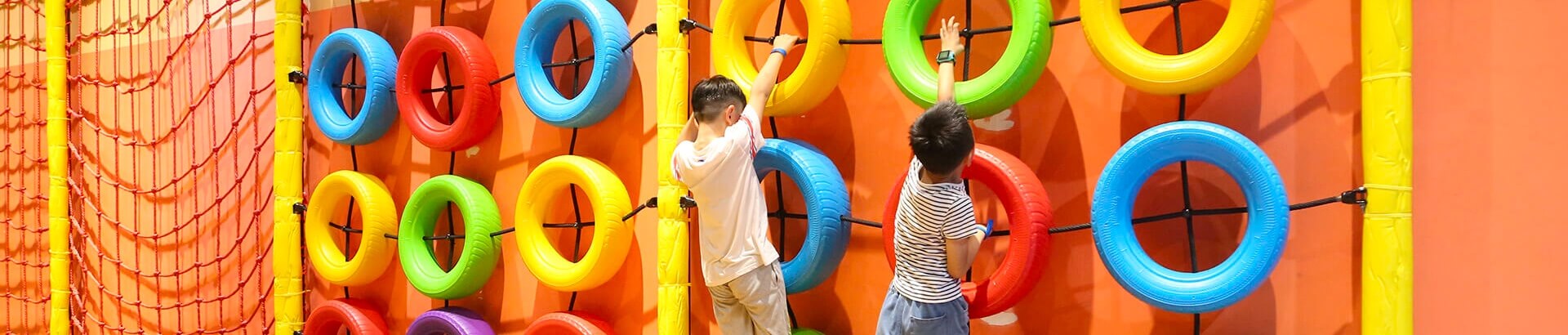
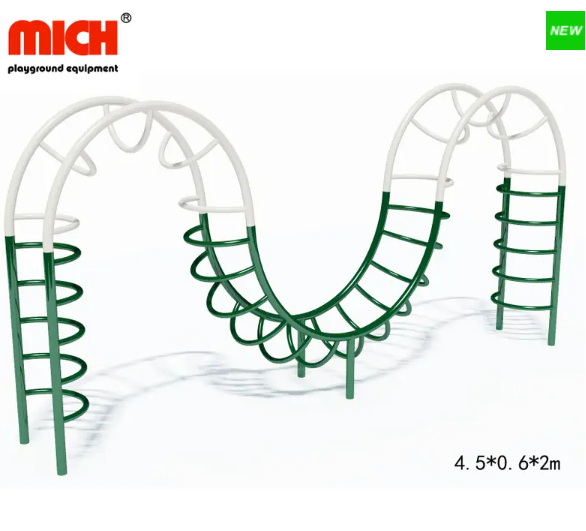
Bridging the gap between play and fitness requires strategic choices. You can utilize climbing nets, ninja courses, and dynamic balance structures. Customizing height parameters and fall zones accommodates children and young teens safely. A ninja warrior course serves as high-intensity interval training for a teenager but functions as an advanced play structure for a younger child. The key is scaling the reach distances and fall heights appropriately.
Evaluating modular systems allows for future expansion as community demographics shift over time. If a neighborhood currently has a high population of toddlers, you install low-level sensory panels and crawl tubes. Ten years later, as those children become teenagers, a modular system allows you to swap those panels for pull-up bars, climbing walls, and agility stations without ripping out the main vertical support posts or re-pouring the concrete footers.
When integrating these structures, you must strictly separate the use zones. A child swinging on a monkey bar cannot share a fall zone with an adult performing heavy squats on a resistance machine. The spatial planning must account for the dynamic movement of both users, ensuring that a failure or fall by one does not result in a collision with the other.
Integrating interactive, game-based fitness structures encourages cooperative group activities and team play. Utilizing competitive markers, touchpoint targets, and group-centric layouts keeps younger demographics engaged. These elements build cardiovascular endurance while fostering social interaction. A multi-station rig equipped with electronic touch targets challenges users to hit specific buttons as they light up, turning a standard agility drill into a competitive game.
Cooperative elements also include tandem equipment, such as dual-user chest presses or face-to-face elliptical machines. These designs allow two people to exercise simultaneously, matching each other's pace or providing mutual encouragement. This social aspect significantly increases retention rates and encourages users to return to the park regularly.
For gamified elements requiring power, solar-powered consoles are mandatory. Hardwiring electrical connections to outdoor fitness stations is prohibitively expensive and introduces severe maintenance liabilities. Self-contained, solar-powered units with heavy-duty polycarbonate screens withstand weather and impact while providing the necessary feedback for timed drills and competitive games.
| Age Group | Primary Focus | Key Equipment Specifications | Safety Standard Alignment |
|---|---|---|---|
| Early Childhood (Ages 2–5) | Sensory integration, basic balance, motor skills | Low crawl tunnels, tactile panels, small climbing structures | ASTM F1487 (Playground) |
| Youth (Ages 5–17) | Agility, cardiovascular health, coordination | Ninja courses, dynamic balance structures, climbing nets | ASTM F1487 (Playground) |
| Adults (Ages 18–55) | Hypertrophy, strength training, HIIT | Calisthenics rigs, pull-up bars, adjustable resistance machines | ASTM F3101 (Fitness) |
| Seniors (Ages 55+) | Joint mobility, fall prevention, active aging | Recumbent cycles, tai chi wheels, assisted squat machines | ASTM F3101 (Fitness) |
The primary focus for toddlers is sensory integration, basic balance, and motor skill development. Isolating toddler-specific zones using specialized low-impact Commercial Playground Equipment prevents dangerous interactions with older youth. Equipment specifications should include low-to-the-ground crawl tunnels, tactile sensory panels, and small-scale climbing structures. The maximum fall height for this demographic should rarely exceed 36 inches. Surfacing must be exceptionally forgiving, and the layout must allow parents to maintain physical proximity at all times. Fencing or natural barriers (like low hedges) should enclose this area to prevent toddlers from wandering into high-traffic fitness zones.
Agility, cardiovascular health, and bodyweight coordination are the main goals for adolescents. Risk mitigation involves preventing entrapment hazards and ensuring pinch-point compliance. Differentiating between play structures and fitness structures ensures alignment with CPSC guidelines. For this age group, equipment must withstand highly dynamic, unpredictable use. Teenagers will attempt to climb on top of shade structures or use equipment in unintended ways. Therefore, all vertical posts must have domed caps, and moving parts must have fully enclosed bearings to prevent crushed fingers. Overhead ladders and climbing walls are highly effective for this demographic.
Adults require equipment for hypertrophy, strength training, and High-Intensity Interval Training. Calisthenics rigs, pull-up bars, dip stations, and heavy-duty adjustable resistance machines are ideal. Evaluating load-bearing capacities and biomechanical alignment prevents repetitive strain injuries. A standard adult pull-up bar must support dynamic loads exceeding 500 pounds to account for weighted vests and explosive muscle-ups. The grip diameter should be between 1.25 and 1.5 inches for optimal ergonomics. Footings for adult equipment must be deeper and wider than those for children's equipment to counteract the increased torque generated by heavier users.
Seniors focus on joint mobility, cardiovascular maintenance, and fall prevention. Recumbent cycles, elliptical walkers with low step-up heights, and assisted squat machines serve this demographic well. Mandatory inclusion of instructional placards with heart-rate guidelines and proper form diagrams ensures safe usage. Equipment for seniors must avoid requiring the user to grip tightly or support their full body weight with their hands, as arthritis is common. Pedals must have heel cups and straps to prevent feet from slipping. The resistance must start at near-zero, allowing users to warm up stiff joints before applying any load.
Creating distinct, visually separated pods for Commercial Playground Equipment and adult fitness mitigates collision risks. Integrated zoning designs a continuous loop or trail system where multi-generational stations are placed sequentially. Engineering sightlines allows parents to utilize adult Outdoor Fitness Equipment while maintaining an unobstructed view of youth play areas. Structuring spaces and pathways accommodates large group activities without impeding individual self-guided users.
When executing a segregated layout, use physical distance and landscaping to define the boundaries. A 20-foot buffer zone planted with low-maintenance native grasses clearly delineates the adult fitness area from the children's play area. This prevents children from treating heavy resistance machines as climbing toys. However, the sightlines must remain clear. A parent performing seated rows must have a direct, unobstructed line of sight to the toddler climbing structure. Avoid planting tall shrubs or installing opaque shade sails between these zones.
For integrated trail systems, place fitness stations at 100-yard intervals along a walking path. Group the stations logically: a warm-up pod with stretching posts and tai chi wheels, followed by an upper-body pod, a lower-body pod, and a cardiovascular cooldown pod. Ensure the path itself is wide enough (minimum 8 feet) to allow runners and wheelchairs to pass safely while users are mounting or dismounting the equipment.
Calculating use zones and fall heights is mandatory for all equipment categories. Evaluating surfacing materials like poured-in-place rubber, engineered wood fiber, or synthetic turf ensures ADA compliance and impact attenuation. You must weigh the trade-offs between upfront surfacing costs and long-term maintenance requirements.
Poured-in-place (PIP) rubber offers the best accessibility for wheelchairs and walkers, making it ideal for senior fitness zones and ADA-compliant play areas. However, it requires a perfectly graded concrete or asphalt sub-base and carries a high initial installation cost. Engineered wood fiber (EWF) is cost-effective upfront but requires constant raking, topping off, and compaction to maintain its impact attenuation and accessibility standards. If you choose EWF, you must install wear mats under high-traffic areas like swings and pull-up bars to prevent displacement.
Clearance zones dictate the layout. A dynamic piece of equipment, like an elliptical walker, requires a minimum 6-foot clearance zone in all directions from its maximum extended moving parts. Static equipment, like a sit-up bench, requires a 4-foot clearance zone. These zones cannot overlap unless the equipment is specifically designed as a multi-station rig by the manufacturer. Adhering to these spacing requirements is critical for passing post-installation safety audits.
Assessing the trade-off between highly adjustable equipment and increased vulnerability to vandalism is crucial. Environmental degradation poses a constant threat. Material specifications matter greatly. Choose marine-grade aluminum over standard galvanized steel where appropriate, particularly in coastal environments where salt spray accelerates corrosion. Always verify the necessity of UV-resistant powder coating to prevent fading and chalking under intense sunlight.
When evaluating adjustable mechanisms, inspect the hardware closely. Are the adjustment pins secured with heavy-duty braided steel lanyards? Are the tracks self-cleaning to prevent sand and dirt from jamming the sliding mechanisms? If a machine requires a specialized tool for basic adjustments, it will fail in a public park setting. The customization must be intuitive and robust enough to withstand a user kicking or forcing the mechanism.
Hardware connections must utilize tamper-resistant, stainless steel bolts. Standard hex bolts will be removed by vandals within weeks. The manufacturer should provide the specific security bits required for maintenance. Furthermore, all structural welds must be continuous and ground smooth to prevent water ingress, which leads to internal rusting and catastrophic structural failure.
Verifying vendor compliance with ASTM F3101 for unsupervised public use is non-negotiable. Independent third-party testing and structural warranties mitigate municipal or corporate liability. Always demand documentation proving adherence to relevant safety standards before finalizing any procurement decisions.
Do not accept self-certification from the manufacturer. Require certificates from recognized testing laboratories (such as IPEMA or TUV) validating that the equipment meets the specific load, entrapment, and impact requirements of the applicable ASTM standards. If a vendor cannot produce these documents, disqualify them immediately.
Review the warranty terms with extreme scrutiny. A "lifetime" warranty on vertical steel posts is standard, but the critical components are the moving parts, bearings, and resistance mechanisms. Ensure the warranty covers these specific elements for a minimum of five years. Understand the process for claiming replacement parts; if the vendor ships parts from overseas with a 12-week lead time, your equipment will sit broken and unusable for an entire season.
Outdoor fitness spaces can be highly customized for different age groups when buyers prioritize adjustable resistance, modular layouts, and demographic-specific zoning. Prioritize vendors offering a blended portfolio of adult fitness and commercial play structures backed by verifiable ASTM compliance. Take the following steps to ensure a successful project:
A: No. Adult outdoor fitness equipment is designed for the biomechanics and weight of users typically 13 years and older. Children should use dedicated commercial playground equipment designed to ASTM F1487 standards.
A: Low-impact, accessible machines such as recumbent cycles, tai chi wheels, and assisted step-up stations are optimal for seniors. These focus on mobility and balance rather than heavy resistance.
A: Daycare playground layouts require specialized commercial playground equipment rated for ages 2–5. They must be completely partitioned from high-activity youth or adult zones to eliminate collision hazards.
A: Space requirements vary widely. A standard multi-station pod requires between 800 and 1,500 square feet to accommodate proper safety use zones and ADA-compliant pathways.
A: Yes, provided they utilize enclosed, weather-proofed systems like internal magnetic or hydraulic pistons. Exposed weight stacks are prone to rust and vandalism and should be avoided.
A: Yes. Any equipment from which a user could fall requires impact-attenuating surfacing. Materials like poured-in-place rubber or engineered wood fiber must meet critical fall height standards.
A: Compliance requires accessible routes to the equipment and proper clear floor space for wheelchair maneuvering. It also mandates the inclusion of specific equipment designed for users with mobility impairments.