- All
- Product Name
- Product Keyword
- Product Model
- Product Summary
- Product Description
- Multi Field Search

Views: 0 Author: Site Editor Publish Time: 2026-08-28 Origin: Site
Parks, municipalities, and schools face increasing pressure today. They must design community spaces going far beyond baseline ADA compliance. True inclusivity has become the new standard for public recreational areas. However, many decision-makers still confuse basic accessibility with genuine inclusivity. Accessibility often just means a wheelchair can enter the physical space. Inclusivity demands equitable engagement for physical, cognitive, sensory, and social needs. You want every child playing together, not just observing from the sidelines. Planners must address distinct physical requirements alongside neurodiversity. This article provides a comprehensive framework for evaluating playground designs, materials, and vendors. We will show you how to ensure your capital investments result in genuinely inclusive, compliant, and durable community assets. You will learn actionable strategies to transform an ordinary play area into a thriving, equitable hub for all abilities.
True inclusivity in an outdoor playground requires addressing physical mobility, neurodiversity, and sensory processing differences.
Unitary surfacing, zero-depth entry points, and high-contrast components are baseline evaluation criteria for equitable play.
Material selection directly impacts safety and maintenance; options like a WPC outdoor playground (Wood Plastic Composite) offer sensory-friendly, low-maintenance alternatives to traditional timber or metal.
Compliance with ADA, ASTM, and CPSC standards should act as a starting point, not the final goal, for vendor evaluation.
You must establish clear success criteria before buying equipment. What does success actually look like? We define success by observing where children spend their time. We must differentiate between a child observing from the sidelines and a child actively playing. Accessible spaces let a wheelchair user reach the site. Inclusive spaces ensure they can interact, spin, slide, and socialize. They sit right in the center of the action alongside their peers.
Industry experts rely on specific frameworks to guide these environments. We can look to the 7 Principles of Inclusive Playground Design. These principles guarantee a comprehensive approach to community planning:
Equitable use: The design provides the same means of use for all users.
Flexibility in use: It accommodates diverse preferences and physical abilities.
Simple and intuitive use: Children instantly understand how to interact.
Perceptible information: Sensory cues guide users effectively regardless of sensory abilities.
Tolerance for error: Equipment minimizes accidental hazards and unintended actions.
Low physical effort: Users can engage without extreme fatigue.
Size and space for approach: Ample room exists for mobility aids and caregivers.
You must design for diverse realities to meet these principles. Consider mobility aid users requiring smooth transitions. Autistic children often need predictable patterns and visual schedules. Individuals who have Down syndrome benefit from varying physical challenges that build core strength. Caregivers dealing with limited mobility also need comfortable seating and clear sightlines. You cannot build a successful space without actively addressing these distinct user profiles.
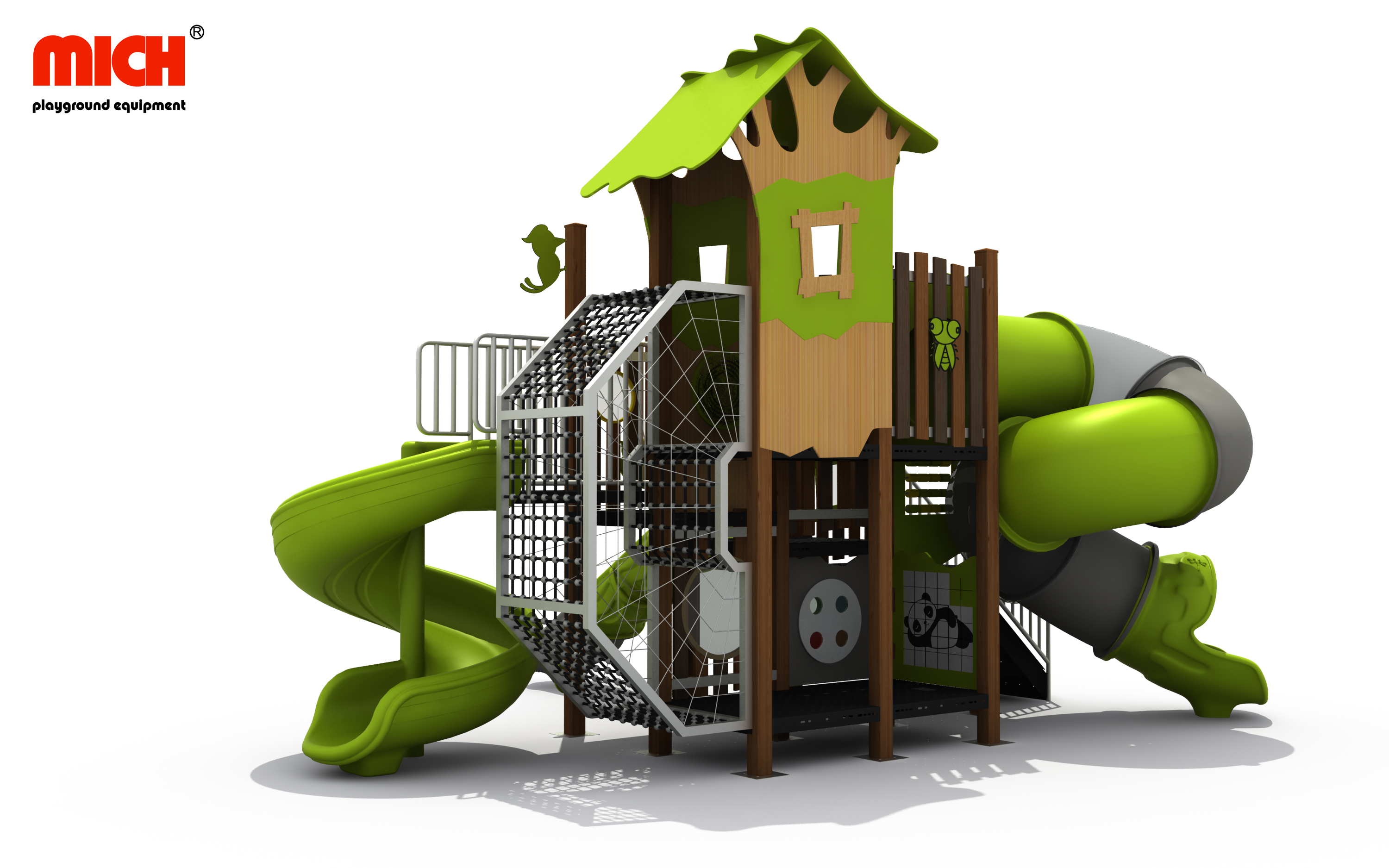
Surface choices dictate usability more than any single piece of equipment. You must evaluate poured-in-place (PIP) rubber or synthetic turf against engineered wood fiber (EWF). PIP rubber offers supreme wheelchair navigability. EWF meets basic compliance but degrades quickly. It requires constant raking to maintain minimum safety depths. Synthetic turf provides a durable, flat surface. When planning an Outdoor Playground, upfront surfacing costs often shock buyers. However, PIP and turf drastically reduce long-term maintenance labor. They guarantee equitable access year-round without daily upkeep.
Visual and tactile feedback matter immensely for cognitive development. Incorporate tactile panels along main pathways. Add musical instruments enabling auditory expression. High-contrast color routing assists visually impaired users. Bright paths guide them safely through the play zones. You create a multi-sensory environment. This keeps children engaged longer and supports sensory regulation.
High-energy play causes sensory overload for some children. Operational success requires quiet pods. These solitary spaces offer necessary retreat. Children can decompress safely away from loud noises. You must balance these quiet areas using multi-user equipment. Inclusive whirls and wide ramps foster cooperative play. They allow multiple children to spin or climb simultaneously, bridging the gap between solitary and social play.
Children need developmental challenges to build confidence. We call this safe risk. Safe risk builds motor skills and resilience. Hazards represent structural dangers you must eliminate. A gap trapping a child's head is a hazard. A wobbly bridge is a safe risk. Eliminate hazards entirely during the design phase. Keep the safe risks to ensure neurotypical and neurodivergent children grow together.
Material choices dictate longevity and daily safety. Traditional wood poses a severe splinter risk for bare hands. Wood also succumbs to rot in damp climates. Steel structures heat up rapidly under direct sun. Hot steel burns skin and causes rust over time. Wood Plastic Composite (WPC) solves these core issues effectively.
A WPC Outdoor Playground provides a beautiful natural aesthetic. It maintains a cooler surface temperature during peak summer hours. WPC eliminates the tactile hazards of splintering wood. This makes it incredibly safe for neurodivergent children. These children often rely heavily on touch to explore their environment. A smooth, predictable surface prevents sensory distress and physical injury.
You must evaluate initial capital expenditure against long-term operating expenses. WPC and synthetic materials often require higher upfront investments. However, they yield significantly lower annual maintenance costs. You save substantial money by eliminating painting, sealing, and splinter repairs. Predictable operating expenses help municipalities manage budgets efficiently over a twenty-year lifespan.
Playground Material Comparison Guide
Material Type | Durability & Climate Response | Safety & Sensory Impact | Maintenance Requirements |
|---|---|---|---|
Traditional Wood | Susceptible to rot, warping, and termite damage in damp climates. | High splinter risk; tactile irregularities can upset neurodivergent children. | High. Requires frequent staining, sealing, and sanding. |
Powder-Coated Steel | Highly durable but prone to rust if scratched. Retains severe heat. | Burn risks in summer; loud auditory feedback when struck. | Medium. Requires touch-up painting and rust mitigation. |
Wood Plastic Composite (WPC) | High resistance to rot, moisture, and UV degradation. | Smooth, splinter-free surface; moderate temperature retention. | Low. Requires basic cleaning without chemical sealants. |
Mandatory alignment begins your project planning. You must follow DOJ 2010 ADA Standards for Accessible Design. ASTM F1487 dictates layout and equipment specifications for public spaces. CPSC guidelines govern general safety practices. These regulatory baselines form the foundation of your project. They are not the final goal. Merely passing an audit does not guarantee an engaging, inclusive space.
Evaluate your vendor based on strict accessibility metrics. Calculate required ramp slopes accurately before approving designs. Determine proper landing dimensions for mobility aid turnaround. Plan transfer station placements based on your total elevated play components. A 1:12 slope is a standard ADA requirement for ramps. Wider ramps allow wheelchairs to pass each other smoothly without forcing one user to reverse.
Many projects fail due to unseen infrastructural elements. Drainage failures under unitary surfacing cause massive operational problems. Puddled water destroys expensive poured rubber from the bottom up. Improper fall zone measurements represent another common trap. Inspectors will fail your site immediately. You face severe liability issues if a child falls onto an unprotected surface. Proper base preparation ensures your surfacing performs correctly for decades.
Never buy equipment before evaluating your specific site. Factor in natural topography heavily. Assess your local drainage patterns during heavy rain. Map out existing underground infrastructure and utility lines. Retrofitting a non-flat site significantly increases base preparation costs. Grading land and moving utilities will drain your equipment budget quickly. You must allocate funds for site preparation first.
Use strict criteria when shortlisting manufacturers for your project. We recommend the following vendor evaluation standards:
Proof of IPEMA Certification: The International Play Equipment Manufacturers Association ensures rigorous third-party testing. Never skip this requirement.
Transparency in Replacement Parts: Ask about standard lead times for replacement components. A broken swing should not close a park for three months.
CPSI Availability: Ensure they provide localized, certified playground safety inspectors for final installation. Proper installation prevents future mechanical failures.
Initiate a comprehensive site audit immediately as your next step. Engage community stakeholders early in the planning process. Parents, occupational therapists, and local disability advocates provide invaluable needs assessments. Finally, request conceptual 3D renderings from your shortlisted vendors. Tie these renderings strictly to fixed quotes. This practice prevents unexpected cost overruns during final construction.
An inclusive community space is a long-term public investment. It requires rigorous upfront planning and stakeholder alignment. We recommend keeping these actionable takeaways in mind as you move forward:
Define your project goals well beyond basic ADA compliance to ensure equitable engagement.
Prioritize inclusive unitary surfacing and sensory-friendly materials like WPC to reduce long-term maintenance.
Eliminate structural hazards while preserving necessary developmental challenges for growing children.
Select vendors who demonstrate successful, audited inclusive designs over those simply selling standalone accessible equipment.
Take action today to transform your community. Request a professional site consultation to begin your topographical evaluation. You should also download an inclusive design evaluation checklist to guide your internal committee planning meetings.
A: Inclusive designs typically require a 20-40% higher baseline budget. This increase covers wider ramps, specialized sensory equipment, and unitary surfacing like poured-in-place rubber. While the initial investment is higher, these durable materials often reduce long-term maintenance expenses.
A: Yes, you can successfully retrofit existing spaces. You might add ground-level sensory panels, musical instruments, or quiet pods. Upgrading the surfacing to a unitary material dramatically improves wheelchair access. You can achieve this without tearing down the existing main structures.
A: WPC (Wood Plastic Composite) provides a predictable, smooth surface. It completely eliminates splinter risks. It maintains a cooler surface temperature compared to steel. This structural integrity offers a sensory-friendly, low-maintenance environment perfectly suited for children who explore through touch.
A: Absolutely. Great inclusive design relies on graduated challenges. Multi-generational play elements offer varying degrees of difficulty. A single structure might feature a gentle transfer station on one side and a complex climbing web on the other. This ensures all children find appropriate developmental challenges.