- All
- Product Name
- Product Keyword
- Product Model
- Product Summary
- Product Description
- Multi Field Search

Views: 0 Author: Site Editor Publish Time: 2026-07-29 Origin: Site
Investing in commercial playground infrastructure carries high stakes. Safety liabilities, strict local compliance laws, and long-term durability requirements dictate the viability of your entire project. Navigating the overseas manufacturing landscape adds another layer of complexity. Buyers constantly face the difficulty of distinguishing between legitimate, high-capacity factories and intermediary trading companies. These middlemen obscure supply chains, inflate lead times, and lack true commercial responsibility when structural issues arise.
This guide provides a systematic, evidence-based framework for evaluating and shortlisting a reliable supplier. We move beyond superficial marketing claims to assess actual engineering capabilities, material specifications, and compliance rigor. By focusing on verifiable data, facility audits, and international safety standards, you can secure high-quality infrastructure that protects your investment and ensures user safety from day one.
A successful procurement strategy balances upfront capital expenditure with long-term asset durability, aesthetic customization, and zero safety infractions. Sourcing play equipment china requires rigorous due diligence to ensure the physical products match the approved digital designs. The supplier you select directly impacts your operational timeline, maintenance overhead, and legal liability.
Understanding the operational differences between direct factories and trading companies is essential. Intermediaries create communication bottlenecks because they must relay technical specifications to the actual factory. This leads to margin stacking, where you pay a premium for the middleman's services without receiving added manufacturing value. Furthermore, trading companies frequently shift liability. If a component fails safety testing, the intermediary may blame the factory, leaving you without a clear path for recourse.
Verifying a factory's identity requires specific documentation checks. Request the company's Chinese business license and translate the "scope of business" section. A true manufacturer will have "manufacturing" or "production" explicitly listed, whereas a trading company will only list "sales" or "distribution." Evaluate their registered capital to gauge financial stability. Verify their ISO 9001 quality management certifications by checking the certificate number with the issuing body. Conducting virtual factory tours or hiring third-party inspection agencies to perform on-site audits provides undeniable proof of their manufacturing capacity.
| Evaluation Metric | Direct Manufacturer | Trading Company |
|---|---|---|
| Business License Scope | Lists "Manufacturing", "Production", "Fabrication" | Lists "Sales", "Trading", "Distribution" |
| Quality Control | Direct oversight of raw materials and assembly | Relies entirely on third-party factory standards |
| Customization | High flexibility, direct access to CAD engineers | Limited flexibility, slow communication loops |
| Accountability | Direct liability for structural failures | Often shifts blame to the hidden partner factory |
Buyers frequently overlook design intellectual property and custom theme capabilities. Settling for off-the-shelf designs results in generic structures that fail to maximize the spatial potential of your facility. Another error is failing to verify the commercial responsibility and liability insurance coverage of the manufacturer. If an incident occurs, you need assurance that the factory stands behind its engineering.
Ignoring local fire-retardancy and toxic chemical regulations is a fast track to failed inspections. Plastics and soft padding must comply with strict limits on phthalates and heavy metals. Assuming a supplier automatically meets your country's specific regulations without requesting documented proof is a dangerous oversight.
Selecting an unverified supplier triggers a cascade of operational failures. Delayed facility openings occur when equipment gets held up in customs due to missing compliance paperwork. Failed local safety inspections force on-site modifications or complete component replacements. Rapid equipment degradation from substandard materials leads to continuous downtime, frustrating users and damaging your facility's reputation.
Evaluating a China Playground Equipment Manufacturer requires a deep dive into their material supply chain and engineering protocols. Superficial visual inspections of product catalogs are insufficient.
Outdoor structural elements demand uncompromising technical requirements. Galvanized steel pipes must have a minimum gauge thickness of 2.0mm to 3.0mm to withstand heavy dynamic loads. Rust-resistant powder coatings should be applied uniformly after sandblasting to ensure maximum adhesion. Platforms and decks require heavy-duty PVC or vinyl finishes that resist impact and prevent slipping.
Plastic components must utilize food-grade, UV-resistant LLDPE (Linear Low-Density Polyethylene). This specific grade prevents fading under direct sunlight and maintains structural flexibility, preventing brittleness and cracking over time. For indoor soft play materials, demand high-density, flame-retardant sponge or foam padding (EPE/XPE). Outer wraps must use non-toxic, phthalate-free PU leather. High-tensile safety netting is mandatory to prevent falls from elevated play zones.
Mandatory regional standards dictate the engineering parameters of play structures. In North America, ASTM F1487 (outdoor) and F1918 (indoor soft play) govern safety. Europe relies on EN 1176 for equipment and EN 1177 for impact-attenuating surfacing. Australia enforces AS 4685. A credible factory will engineer their products to meet or exceed the specific standards of your target market.
Never accept a certificate at face value. Instruct your procurement team to verify certificates directly with issuing bodies like SGS, TUV Rheinland, or Intertek. Forged documentation is a known risk. Ensure the manufacturer's name on the test report exactly matches the name on the business license. Mismatched names indicate a trading company using a partner factory's credentials.
Assess the supplier's ability to translate complex floor plans into compliant, precise 3D models. They must account for structural load calculations, ensuring the frame can support maximum user capacity. Clearance zone safety buffers are non-negotiable; the design must maintain specific distances between moving parts and stationary structures to prevent entrapment hazards. Spatial optimization ensures high-traffic commercial environments flow naturally without creating dangerous bottlenecks.
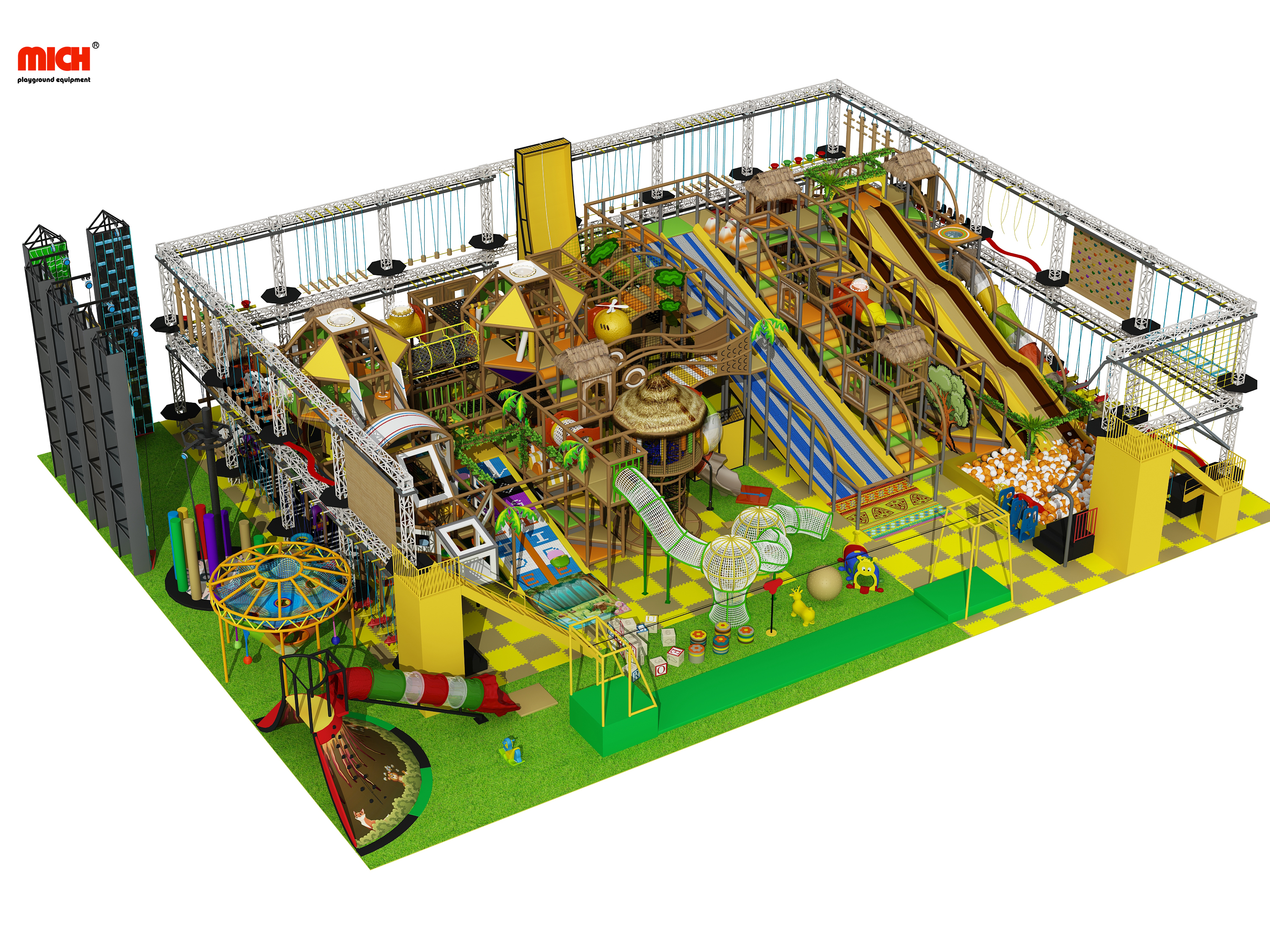
Different environments demand entirely different manufacturing approaches. Understanding these distinctions ensures you procure the correct infrastructure for your specific site conditions.
Indoor and outdoor systems have differing manufacturing requirements and material tolerances. Outdoor equipment faces severe environmental wear-and-tear from UV exposure, rain, and temperature fluctuations. It requires heavy-duty steel, UV-stabilized plastics, and specialized safety surfacing like poured-in-place EPDM rubber. Indoor systems focus heavily on impact attenuation through soft padding, fire-retardant materials, and maximizing vertical space within enclosed structures. The safety surfacing indoors often utilizes interlocking EVA foam mats or carpeted foam tiles.
Select a supplier whose systems allow for phased expansions. Modular designs feature interchangeable parts, allowing you to integrate new play features or expand the footprint without requiring a total system overhaul. This scalability extends the lifespan of your facility, keeping the attraction fresh for returning visitors while minimizing future capital expenditures.
Evaluating the true financial impact of your procurement decision requires looking far beyond the initial factory quote. Hidden expenses quickly accumulate if you do not account for the entire logistics and maintenance lifecycle.
Deconstruct the true cost of importing infrastructure. A quote that appears cheaper upfront can easily result in significantly higher long-term expenses. Inferior materials require premature replacement. A lack of UV stabilizers causes plastics to degrade and crack within two years. Substandard powder coating leads to structural corrosion, forcing you to shut down the facility for emergency repairs. Investing in higher-grade materials initially prevents these costly disruptions.
Logistical realities heavily influence your final budget. Understand the difference between FOB (Free on Board) and CIF (Cost, Insurance, and Freight) terms. FOB means you control the freight forwarder and shipping costs once the goods are loaded at the Chinese port. Container volume optimization is necessary; accurate CBM (Cubic Meter) calculations ensure you aren't paying to ship empty space. Factor in import duties, customs clearance fees, and the cost of local freight forwarders to transport the container from your local port to the installation site.
Analyze standard warranty lengths for different components. Legitimate factories typically offer 5 to 10 years for steel frames, while soft padding and moving parts may only carry a 1 to 2-year warranty due to expected wear and tear. Address the practical challenges of claiming warranties overseas. Determine how the supplier handles replacement parts. Will they expedite shipping for critical components, or will you wait months for a replacement to arrive via sea freight?
The final stages of production and delivery carry significant risks. Proactive quality control and careful installation planning are essential to bring the project to a successful close.
Implement strict pre-shipment inspections (PSI) and factory acceptance testing (FAT). Never authorize final payment until the equipment passes these checks. Demand a physical trial assembly at the factory. The manufacturer must erect the core structural components on their production floor. This allows inspectors to check safety clearances, verify bolt hole alignments, and test overall stability before the equipment is dismantled and loaded into the shipping container.
Evaluate your installation options carefully. DIY installation using factory-provided manuals is only viable for small, simple structures. For large-scale commercial setups, you must hire local certified playground installers or negotiate to fly out the manufacturer's engineering team. Poor installation manuals are a major risk. Vet a supplier's documentation and CAD schematics prior to final payment to ensure your local team can actually decipher the assembly instructions.
Sourcing commercial play infrastructure requires rigorous due diligence. Treat the supplier as a long-term operational partner rather than a one-off vendor. Verify direct manufacturing status, validate international safety certificates, and assess design flexibility before committing funds.
A: Request their Chinese business license and check the registered scope of business. A direct factory will explicitly list manufacturing or production. You should also verify their ISO 9001 certification, check their registered capital, and demand a live video tour of the production floor.
A: Buyers often chase the lowest price, ignoring material gauge thickness and UV resistance. They also fail to verify third-party safety testing certificates, neglect to check liability insurance, and overlook the importance of clear, English-language installation manuals.
A: Certifications depend on your region. North America requires ASTM F1487 for outdoor and ASTM F1918 for indoor. Europe requires EN 1176 and EN 1177. Australia uses AS 4685. Always verify these certificates directly with the issuing body like TUV or SGS.
A: Ask for a copy of their business license and use a translation tool or service to read the details. You can also hire a local sourcing agent or a third-party inspection firm in China to perform a basic background check and verify their legal standing.
A: Many large manufacturers offer the option to send an engineer or installation team to your site to supervise local labor. The buyer is typically responsible for covering the engineers' visa fees, flights, accommodation, and a daily wage.
A: Establish clear warranty terms in your purchase contract before paying the deposit. Specify which components are covered and for how long. Ensure the contract dictates that the supplier will cover expedited air freight for critical replacement parts due to manufacturing defects.