- All
- Product Name
- Product Keyword
- Product Model
- Product Summary
- Product Description
- Multi Field Search

Views: 0 Author: Site Editor Publish Time: 2026-08-28 Origin: Site
Mixing toddlers and older children in a single play space creates severe safety hazards. It significantly increases collision risks, exposes facilities to legal liability, and restricts the developmental value of the equipment. Decision-makers face high stakes when planning these areas. For schools, municipalities, and HOAs, proper zoning goes far beyond simple aesthetics. It serves as a fundamental requirement for CPSC compliance and proactive risk mitigation. If you fail to separate these zones, you invite preventable injuries into your community spaces.
This article offers an evidence-based guide to evaluating spatial planning, traffic flow, and material durability. We will help you build safe, multi-age outdoor spaces effectively. You will discover practical methods to separate active zones from exploratory areas. We explain how smart design protects children and ensures ongoing compliance.
Strict Age Brackets are Standard: CPSC guidelines mandate distinct equipment and spatial separation for children ages 2–5 and 5–12.
Flow is as Critical as Distance: Effective zoning uses physical buffers, clear sightlines, and logical pathways to prevent accidental cross-traffic between age groups.
Material Selection Impacts Zoning Durability: Utilizing high-yield materials like WPC (Wood-Plastic Composite) for borders, seating, and transitions reduces maintenance and supports clear visual boundaries.
Compliance Mitigates Liability: Adhering to spatial separation standards directly influences safety audits and insurance premiums for mixed-use public spaces.
Designing an effective play space requires understanding the regulatory framework guiding user safety. You cannot simply install equipment randomly and expect positive outcomes. Creating a compliant layout protects facilities from lawsuits and ensures children play securely.
The Consumer Product Safety Commission (CPSC) establishes the gold standard for playground safety. Their guidelines divide users into three distinct developmental categories. Facilities must adhere to these brackets to maintain compliance:
Ages 6-23 months: Requires crawling areas, low steps, and secure bucket swings.
Ages 2-5 years (Preschool): Needs exploratory equipment, small slides, and low-level climbing structures.
Ages 5-12 years (School Age): Demands complex climbing geometries, overhead rings, and taller slides.
You must address the physical realities of mixing different age groups. A 10-year-old child generates significant velocity during play. This momentum fundamentally conflicts against a 3-year-old’s limited spatial awareness. Lack of zoning leads directly to the highest percentage of playground collisions. When older children run through a toddler zone to reach a swing, accidents happen instantly. Strict age-appropriate zoning acts as your primary defense against injury claims and high insurance premiums.
Older children require greater physical challenges to stay engaged. They need overhead rings, tall vertical climbers, and fast slides. However, these features present active fall hazards for toddlers. A preschooler attempting to navigate a tall chain climber risks severe injury. By separating the spaces, you ensure every child interacts only with developmentally appropriate challenges.
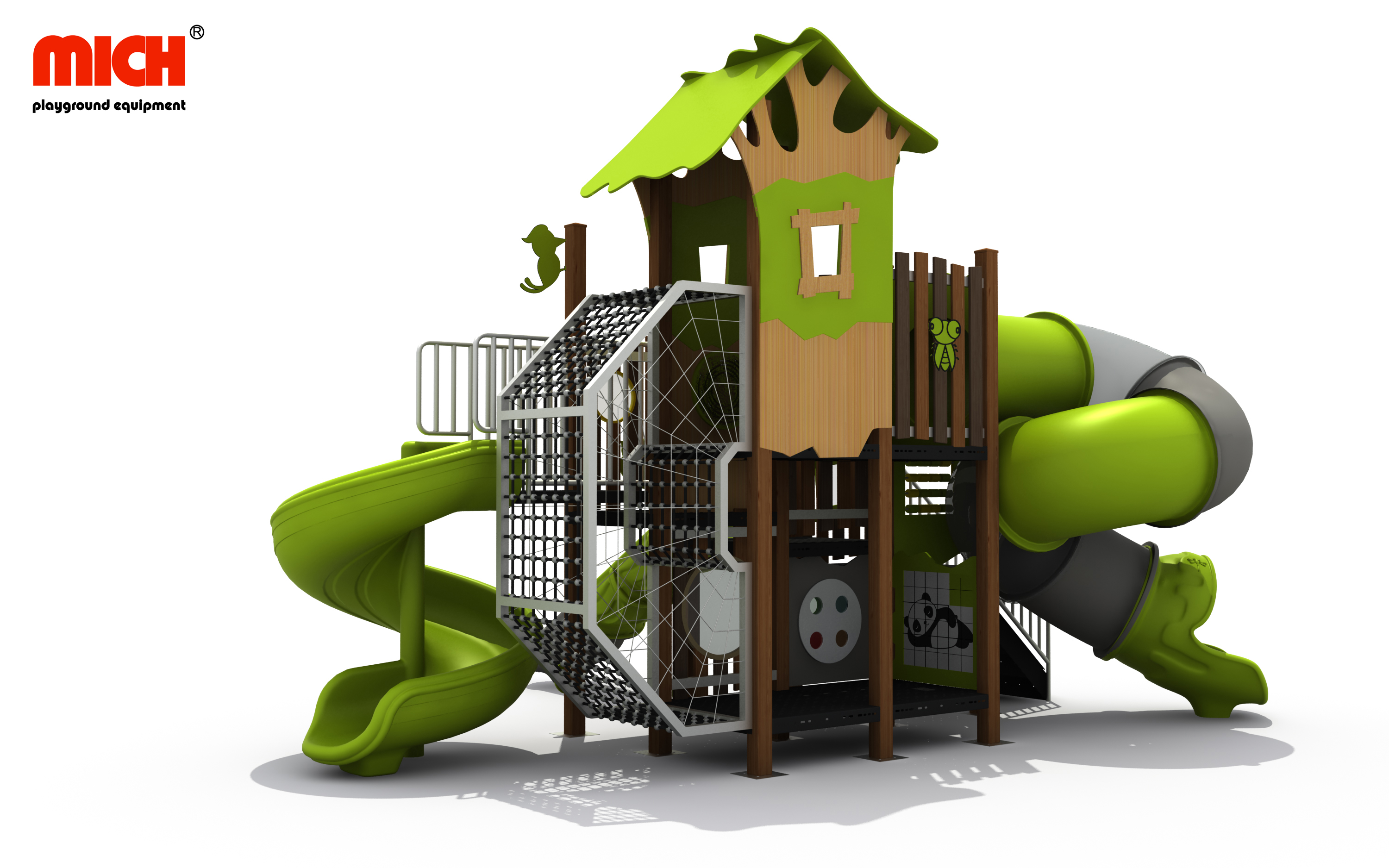
Every well-designed Outdoor Playground treats different age zones as independent ecosystems. You must evaluate each area based on height limits, visibility, and spatial capacity.
Toddlers interact with their environment through exploration rather than high-speed movement. Planners must focus on containment and accessibility.
Height Limits: Equipment must remain scaled down appropriately. CPSC guidelines typically dictate maximum fall heights of four to five feet for this age group.
Sightlines: Caregivers need unobstructed views. Structures should never feature blind spots. Parents must spot potential trouble from seating areas instantly.
Enclosure: Toddlers wander easily. This zone often benefits heavily from semi-enclosed fencing or distinct physical borders to keep young children contained safely.
School-aged children use equipment vigorously. They require spaces accommodating high energy and rapid movement.
Scale & Velocity: Planners must incorporate taller structures and wider swings. Complex climbing geometries keep older kids physically engaged.
Open Spacing: Higher momentum demands larger use-zones. Fall zones around these structures must provide ample clearance to prevent secondary collisions.
Table 1: Zoning Evaluation Metrics
Evaluation Dimension | Ages 2-5 (Exploratory) | Ages 5-12 (Active) |
|---|---|---|
Maximum Fall Height | 4 to 5 feet | Up to 8+ feet (varies by equipment) |
Use-Zone Clearances | Standard overlapping permitted on specific stationary gear | Expanded clearance for moving equipment (swings/zip lines) |
Enclosure Needs | High (fencing or dense natural borders) | Low (open access preferred) |
Caregiver Sightlines | Critical (zero blind spots required) | Moderate (general supervision) |
Placing equipment at correct distances only solves half the problem. You must manage how users move through the space. Poor traffic flow creates dangerous bottlenecks.
You can separate areas effectively without necessarily building high walls. Intelligent design uses natural elements as physical dividers. You might incorporate dense landscaping or natural topography to split the space. Central seating areas also serve as excellent physical barriers. These buffers clearly signal a transition between the active and exploratory areas.
Pathways should guide users intuitively. You want to prevent fast-moving teenagers from crossing toddler zones. Follow these steps for effective traffic routing:
Position the main entrance centrally, allowing immediate diverging paths.
Route the 5-12 pathway directly toward high-velocity equipment like swings.
Place the 2-5 exploratory zone closer to primary seating areas.
Eliminate straight-line running paths connecting the two zones directly.
Designing pathways this way ensures older kids never sprint through the toddler area.
Many families bring multiple children of different ages. Caregivers need to monitor a toddler and a ten-year-old simultaneously. You should plan seating and rest areas strategically between zones. Placing benches inside the buffer area allows parents to maintain visual contact across both playgrounds effortlessly.
Spatial planning relies heavily on tactile and visual cues. The materials you choose directly dictate how well children understand the boundaries. Smart material selection also impacts long-term durability.
Visual cues help children recognize distinct areas instinctively. A change in pathway texture or border color signals a shift in the play environment. Parents use these same cues to enforce rules. Using distinct materials for the 2-5 and 5-12 borders makes boundary enforcement much easier.
Modern planners frequently replace traditional timber. They specify advanced composites for infrastructure needs.
Application: You will find WPC ideal for decking, transitional bridges, retaining walls, and perimeter seating. It handles ground contact exceptionally well.
Performance Benefits: A WPC Outdoor Playground infrastructure significantly outpaces traditional wood. It never splinters, ensuring toddler safety. It offers high moisture resistance, preventing rot in damp climates. Unlike older wood products, WPC requires no chemical treatments. It also regulates temperature better than raw metal borders.
Visual Distinction: Manufacturers offer composites in various shades. You can use different colored WPC borders to subtly color-code the 2-5 and 5-12 play areas. For example, warm earth tones might frame the toddler area, while vibrant modern tones frame the active zone.
Theoretical zoning concepts often clash against practical constraints. Planners frequently face tight budgets and restrictive land plots. You must navigate these hurdles creatively.
Compact areas present unique challenges. Dense urban HOAs or small schoolyards rarely offer sprawling acreage. You must employ smart strategies to overlap safety use-zones legally. CPSC guidelines sometimes allow stationary equipment use-zones to overlap if height requirements align. However, you can never overlap the fall zones of moving equipment like swings. Utilizing vertical topography helps maximize tight footprints safely.
Funding rarely arrives all at once. Municipalities often build play spaces across several years. Designing a comprehensive master plan allows a facility to install the 5-12 active zone first. You can then budget for the 2-5 exploratory zone in the next fiscal year. Proper initial traffic mapping ensures this second installation never disrupts site flow later.
Selecting the right vendor makes or breaks your zoning strategy. Avoid suppliers offering only standalone equipment catalogs. Instead, shortlist vendors providing site-specific CAD drawings. These technical drawings prove CPSC compliance before construction begins. They also map traffic flow comprehensively. Demand visual proof showing exactly how your chosen equipment respects buffer spaces and sightline requirements.
Effective zoning demands more than dropping equipment onto an empty field. It requires a thoughtful combination of strict compliance, intelligent traffic flow, and durable material choices. You must separate the 2-5 and 5-12 age brackets explicitly. Doing so protects young children from high-impact collisions and allows older kids to play freely.
Remember to evaluate materials based on long-term safety and maintenance reduction. Eliminating splinters and rot ensures your safety buffers remain intact year after year. Always prioritize clear sightlines and logical pathways to keep cross-traffic practically nonexistent.
We strongly encourage decision-makers to request a professional site assessment. Ask your manufacturer for a 3D flow analysis before committing to an equipment purchase. Taking this crucial step guarantees a safe, compliant, and highly engaging environment for every child.
A: CPSC guidelines highly recommend physical separation between age zones. You can achieve this using buffer areas or landscaping. Literal fencing usually becomes mandatory only based on local municipal codes. Specific site hazards also dictate fencing needs. If you build near busy roads or open water, strict fencing rules apply. Otherwise, natural dividers often suffice.
A: Standard safety guidelines mandate non-overlapping use-zones for different age brackets. Typically, you must provide at least six to nine feet of clearance between structures. This distance depends heavily on equipment height and type. Swings and tall slides require much larger fall zones due to higher momentum. Always consult manufacturer specifications regarding spacing.
A: WPC eliminates the need for seasonal staining and sealing. It actively resists rot in high-moisture areas where ground contact occurs frequently. This material also prevents dangerous safety hazards like splinters. By using durable composites in high-traffic transition zones, you reduce emergency repairs. Facility managers spend less time replacing damaged boards and more time supervising safe play.