- All
- Product Name
- Product Keyword
- Product Model
- Product Summary
- Product Description
- Multi Field Search

Views: 10 Author: Site Editor Publish Time: 2025-10-16 Origin: Site
The question "Is a bigger trampoline safer?" appears simple, but the answer is anything but, especially when moving from a residential backyard setting to the massive, purpose-built environments of a Trampoline Park. In the booming family entertainment sector, where concepts like altitude trampoline park, airbound trampoline park, helium trampoline park, and jump trampoline park dominate, size is often equated with fun and capacity. However, from an objective safety standpoint, a larger jumping area introduces a complex matrix of engineering, supervision, and operational challenges that directly influence the risk profile for every jumper.
This comprehensive guide delves into the data and design principles that govern safety in commercial bouncing environments, analyzing how the scale of a Trampoline Park impacts user risk and what operators and customers need to understand.
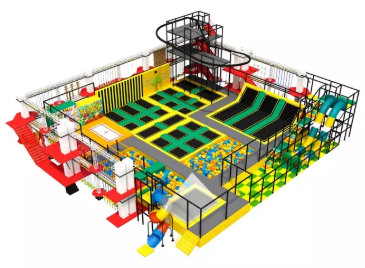
In a residential setting, a larger, single-user trampoline offers more space to correct a bad bounce, which can be seen as a safety advantage. In a commercial Trampoline Park, the dynamic changes entirely. Commercial trampolines are interconnected, designed for heavy-duty use, and often facilitate higher, more aggressive bounces.
While the term "bigger" might refer to the overall footprint of the park, it more specifically refers to the size of the individual trampoline beds or the height they allow jumpers to achieve. Data consistently shows that injuries in commercial settings tend to be more severe than those on backyard trampolines.
Injury Location | Severity Comparison (Park vs. Home) | Key Contributing Factor |
Lower Extremities (Ankle, Tibia/Fibula) | Higher frequency of fractures/dislocations (up to 55% of injuries) | Higher bounce heights enabled by professional-grade trampoline park equipment and deeper beds, leading to greater impact force upon landing. |
Upper Extremities (Forearm, Elbow) | Common, often requiring surgery | Collision between multiple jumpers, or awkward landing when trying to recover from a high or uncontrolled bounce in a larger area. |
Head and Neck | Rare but most severe (spinal injuries) | Attempting complex tricks like flips in a larger space without sufficient skill or supervision. |
The severity of injuries at a Trampoline Park suggests that while the large size provides more room, it simultaneously enables higher energy activities that, when things go wrong, result in catastrophic outcomes. The risk is not in the space itself, but in the amplified physics it facilitates.
A commercial trampoline park manufacturer must adhere to rigorous safety standards (such as ASTM F2970) that go far beyond consumer-grade products. The scale necessitates specialized design.
Frame and Construction: Larger park installations require heavy-duty, reinforced galvanized steel frames to handle the constant, high-impact force from hundreds of jumpers daily. The stability of the entire system, essential for safety, relies on this robust construction.
Spring System: Commercial springs are longer and heavier gauge, designed for longevity and a higher, more consistent bounce—which directly contributes to the paradox of scale.
Padding and Nets: The gaps between larger, interconnected trampolines must be covered with thick, high-density padding. Safety netting around the perimeter and between attractions like the basketball trampoline park areas is crucial to prevent falling off the edge, which is an amplified risk in a huge park layout.
Beyond the physical dimensions, operational procedures dictate safety, particularly in a large, complex venue. A sprawling Trampoline Park needs more dedicated, trained staff to monitor the large areas effectively.
One of the most critical operational safety measures is the strict adherence to weight limit at trampoline park policies.
Single Jumper Rule: The consensus among safety experts is that 75% of injuries occur when multiple individuals jump on the same mat. In a large Trampoline Park, the "double-bounce" effect is amplified, meaning a heavier jumper landing near a lighter one can launch the smaller person unpredictably, leading to injury. This is why strict adherence to "one jumper per mat" is paramount, regardless of the overall park size.
Toddler Time and Age Limits: The industry trend of offering dedicated sessions like trampoline park toddler time is a direct response to the size paradox. By separating smaller, less coordinated children (who are most vulnerable to head injuries) from older, more powerful jumpers, the park mitigates risk. The trampoline park age limit for general access is often in place to ensure all participants have a basic level of control and spatial awareness.
In a large facility like ninja kidz trampoline park or any extensive Trampoline Park, the ratio of trained staff to jumpers is the single biggest operational safety factor. Staff must be present to enforce rules like "one jumper per mat," ensure all guests are wearing mandatory grip socks for trampoline park, and watch for dangerous stunts. An efficient large park uses different colored socks for trampoline park for general admission vs. specific activity areas (like performance trampolines) to aid staff supervision.
The safety equation is inextricably linked to the business model of a Trampoline Park.
For aspiring owners, understanding the costs of safety is essential. Questions like how much does it cost to open a trampoline park are heavily influenced by the required safety infrastructure.
Cost Component | Impact on Safety and Scale |
Equipment & Manufacturing | Investing in a reputable trampoline park manufacturer ensures commercial-grade safety certifications, crucial for parks like altitude trampoline park. |
Space/Real Estate | A larger footprint increases the distance staff must cover, demanding more personnel and potentially smart camera systems for effective supervision. |
Insurance | Liability insurance premiums are directly tied to the perceived risk, which includes injury data. Strict adherence to safety standards is necessary to minimize this cost. |
Maintenance | Larger parks have more trampoline park equipment (mats, springs, foam pits) that requires daily inspection and replacement to maintain safety integrity. |
For many, how to start a trampoline park begins with securing a business plan that factors in these non-negotiable safety expenses.
The modern Trampoline Park is moving beyond simple open-jump areas to integrate high-tech attractions, which introduces new, scale-dependent risks:
Glow-in-the-Dark Trampoline Park: Nighttime or low-light themes create an incredibly fun atmosphere but can compromise visibility. Extra lighting, staff with dedicated searchlights, and glow-in-the-dark lines/markers become necessary safety additions in these environments.
Ninja Warrior Courses: Integrated into the park (like in a ninja kidz trampoline park), these require separate, specific safety mats and staff training, as the risk profile is more akin to rock climbing than jumping.
Augmented Reality (AR) Jumping: While offering new engagement, these setups must be designed to avoid distraction and maintain safe jump lanes.
For the customer, safety is primarily experienced through adherence to the rules and the quality of their visit. Knowing what to wear trampoline park guidelines emphasize grip socks for trampoline park and comfortable athletic clothing is step one in self-protection.
The popularity of programs like a trampoline park summer pass or trampoline park summer camp means a high volume of repeat visitors. Park safety must be consistently reinforced throughout these longer, more intensive sessions.
The trampoline park birthday party is a major revenue stream, but managing groups of excited children introduces a high-risk factor. Dedicated party hosts and clear instructions are mandatory to prevent collisions and rule-breaking in the larger, more exciting open jump areas. Many successful parks like helium trampoline park have specialized party zones to isolate this high-energy activity.
The following table demonstrates how commercial-grade safety features are applied across different park concepts, proving that the solution to "Is a bigger trampoline safer?" is not just size, but the technology and rules surrounding it.
Park Concept/Feature | Primary Risk Mitigated | Safety Engineering/Protocol |
General Open Jump (Large Area) | Multi-jumper collisions, falling off the edge | Mandatory single-jumper rule, seamless high-density padding between mats. |
Basketball Trampoline Park | Landing outside the mat, hitting the hoop/structure | Specialized padding around all structural poles; deep foam pits or air bags at the dunk landing zone. |
Glow in the Dark Trampoline Park | Reduced visibility of other jumpers/hazards | UV-reactive safety materials, high-visibility glow-in-the-dark socks for trampoline park. |
Toddler Time Section | Collision with larger children/adults | Dedicated area separation, lower spring tension for reduced bounce height, reinforced trampoline park age limit enforcement. |
Jump Trampoline Park (High Performance) | Spinal/head injury from advanced tricks | Trained spotters, weight limit at trampoline park for equipment, and highly specific landing instructions. |
Ultimately, the safety of a Trampoline Park is not a function of its physical dimensions, but rather the degree of control the operator exerts over the environment and the jumpers.
A larger jumping surface only becomes "safer" when it is coupled with professional-grade trampoline park equipment and strict operational protocols that mitigate the increased risk of higher-energy activities:
1. Professional Equipment: Investment in high-quality materials from a reputable trampoline park manufacturer that can withstand high weight limit at trampoline park demands.
2. Rigorous Supervision: A high staff-to-jumper ratio to enforce the one-jumper rule and patrol all zones, from the basketball trampoline park to the main area.
3. Clear Segmentation: Separation of activities and age groups (e.g., trampoline park toddler time vs. general jump) to control the dynamic forces between participants.
4. Mandatory Gear: Enforcement of rules like wearing non-slip socks for trampoline park to prevent falls caused by poor grip.
In summary, the sheer size of an airbound trampoline park or any large commercial venue increases the potential for both incredible fun and severe injury. The true measure of safety lies in the meticulous design, maintenance, and rules that harness that size, ensuring that every customer, whether attending a trampoline park summer camp or a trampoline park birthday party, has a fun, secure experience.
Q1: Does a larger Trampoline Park mean it's safer?
Not necessarily. The size of a commercial Trampoline Park provides more space but also allows for higher, more intense jumps. Safety is determined by strict rules (like the one-jumper rule), professional trampoline park equipment from a certified trampoline park manufacturer, and high-quality staff supervision. A larger park requires more stringent control measures to manage the increased energy and risk.
Q2: What is the importance of the weight limit at trampoline park and age separation?
The weight limit at trampoline park policies are crucial to prevent equipment failure and severe injury. Similarly, age separation—often managed through programs like trampoline park toddler time or enforcing a specific trampoline park age limit—protects smaller, lighter jumpers from the "double-bounce" effect caused by collision with heavier participants.
Q3: Why are grip socks for trampoline park mandatory, and what should I wear?
Special grip socks for trampoline park are required to provide necessary traction on the performance mats, preventing slips and falls that can lead to sprains and fractures. For attire (what to wear trampoline park), comfortable, athletic clothing without sharp accessories is recommended. If visiting a themed venue like a glow in the dark trampoline park, ensure all clothing is functional and adheres to the park's specific guidelines.
Q4: Beyond jumping, what are the safety rules for attractions like the basketball trampoline park?
Specific rules apply to specialized zones, often based on the high-energy activities. For the basketball trampoline park or areas like a ninja kidz trampoline park, jumpers must ensure the landing zone is clear, follow one-at-a-time rules, and adhere to staff instructions to prevent collisions and awkward landings, even during high-traffic periods like a trampoline park birthday party or when using a trampoline park summer pass.