- All
- Product Name
- Product Keyword
- Product Model
- Product Summary
- Product Description
- Multi Field Search

Views: 21 Author: Site Editor Publish Time: 2027-03-23 Origin: Site
Investing in an indoor trampoline park is no longer just a trend-driven business idea. It has become a serious opportunity in the family entertainment industry, attracting entrepreneurs, shopping mall developers, leisure center operators, and investors who want to create interactive spaces for children, teenagers, and families. As consumers continue to seek healthier, more social, and more experience-based forms of recreation, the demand for a high-quality trampoline park has grown steadily across many markets.
However, purchasing and building an indoor trampoline park is far more complex than simply choosing a few trampoline beds and placing them inside a building. The success of the project depends on thoughtful planning, the right layout, proper equipment selection, customer age positioning, local safety standards, operational strategy, and long-term maintenance considerations. A poor purchasing decision can lead to wasted budget, inefficient use of space, reduced customer satisfaction, and avoidable safety risks. A smart purchasing decision, on the other hand, creates a profitable, attractive, and sustainable entertainment destination.
This guide is designed for buyers who want to understand the full process of purchasing an indoor trampoline park. Whether you are opening your first project or expanding your entertainment business, this article will help you evaluate the key factors that influence design, equipment selection, budgeting, supplier choice, and operational success.
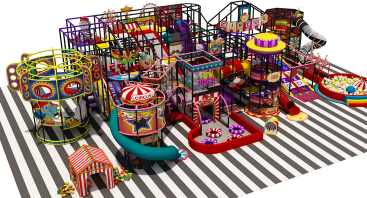
When people first think about building a trampoline park, they often focus on appearance. They imagine colorful equipment, energetic children, and exciting jump zones. While visual appeal is important, the real purchasing decision should go much deeper. A trampoline park is a system, not a single product. Every equipment choice affects safety, visitor flow, age suitability, staffing needs, and revenue performance.
A good purchasing strategy helps you:
match the park to your target customer group
use the available indoor space efficiently
balance excitement with safety
control installation and maintenance costs
plan for future upgrades and expansions
improve customer experience and repeat visits
create a stronger return on investment
Buying a trampoline park without a clear strategy often leads to common mistakes such as choosing too many similar attractions, ignoring age separation, underestimating ceiling height needs, selecting weak materials, or failing to leave enough room for circulation and supervision.
Before purchasing any equipment, you need to define what kind of trampoline park you want to build. This is one of the most important steps in the entire process.
Different customer groups require different layouts and equipment combinations. Ask yourself whether your main visitors will be:
toddlers and young children
school-age children
teenagers
families with mixed-age children
students and young adults
birthday party groups
shopping mall walk-in traffic
A trampoline park designed mainly for younger children should include softer attractions, lower-impact play zones, and family-friendly features. A park targeting teenagers may need more dynamic elements such as free jump courts, slam dunk zones, obstacle challenges, and performance-focused activities. A family-centered venue often works best when trampoline attractions are combined with soft play, climbing, and party areas.
Your purchasing decisions should also reflect your brand position. Are you building:
a compact community entertainment venue
a premium family entertainment center
a large regional attraction
a sports-oriented trampoline experience
a mixed indoor playground and trampoline park
A premium trampoline park may justify investing in customized design, stronger theming, advanced attractions, and integrated customer spaces such as cafés or party rooms. A smaller local venue may focus more on efficient space use and essential equipment that offers a fast return.
The physical location has a major influence on what kind of trampoline park you can build. Many buyers make the mistake of choosing equipment first and then trying to fit it into the venue. The smarter approach is the opposite.
Ceiling height is one of the most critical factors for any indoor trampoline park. Jumping activities require safe overhead space, especially for older children and more active attractions. Low ceilings can severely limit what equipment you can install.
A square or rectangular venue is generally easier to design efficiently than an irregular shape with many columns or narrow sections. Buyers should look at:
total usable floor area
entrance and reception location
support columns
emergency exits
wall positions
circulation paths
party room potential
parent seating possibilities
Commercial trampoline systems create repeated dynamic use. The building structure, flooring condition, and installation foundation should all be assessed before finalizing the purchasing plan.
Before purchasing a trampoline park, buyers should understand local fire regulations, safety compliance rules, building codes, and any certification requirements. These requirements may affect materials, spacing, fencing, emergency access, signage, and maximum occupancy.
Not every trampoline park should have the same attractions. The best equipment mix depends on your customer group, venue size, local competition, and budget.
The main jump court is usually the foundation of a trampoline park. It offers open jumping and serves as the central visual attraction. This area should be durable, spacious, and easy to supervise.
These areas are popular because they create excitement and allow users to attempt more adventurous movements. They are often combined with angled trampolines or performance lanes. Buyers should consider maintenance, cleaning, and safety supervision when choosing between foam pits and airbag systems.
Dodgeball courts add a social and competitive dimension to a trampoline park. They are especially attractive for groups, school events, and teenagers. However, they need enough space and controlled usage rules.
This feature is a classic attraction in many parks because it delivers an immediate sense of achievement and fun. It is visually appealing and highly shareable on social media.
Adding obstacle-style equipment can help a trampoline park appeal to a wider audience and offer more variety than jumping alone. This is especially useful if you want to increase repeat visits.
A dedicated toddler zone is highly recommended if you want to attract families. Younger children need separated, lower-intensity play areas. This can make the venue safer and more inclusive.
Some parks include digital games, projection systems, climbing walls, soft play zones, slides, spider towers, or role-play spaces. These additions can help reduce age limitations and make the trampoline park more of a complete family entertainment center.
One of the smartest purchasing decisions is to plan the park around age segmentation. A successful trampoline park is not just fun, it is organized in a way that different customer groups can enjoy safely and comfortably.
This group needs:
soft and low-height equipment
enclosed areas
parent visibility
slow-paced play
separate access from larger jumpers
This is often the core customer group for many family venues. They enjoy jumping, climbing, obstacle play, and party activities. Equipment should be exciting but still easy to supervise.
This group often wants faster-paced, more challenging features. They are attracted to social activities, competition zones, and skill-based attractions.
Many of the most successful venues are designed for siblings of different ages. If your trampoline park can provide a satisfying experience for toddlers, children, and older kids in one visit, parents are much more likely to return.
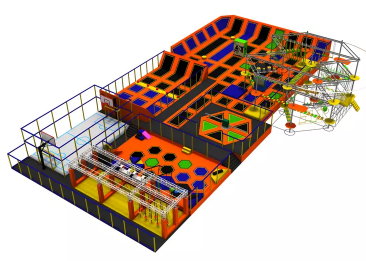
When purchasing a trampoline park, buyers should never focus only on the price. Material quality directly affects durability, maintenance frequency, customer safety, and brand reputation.
The steel frame should be strong, stable, and suitable for commercial use. Thickness, anti-rust treatment, and welding quality all matter.
The jumping surface should provide consistent elasticity, strong wear resistance, and reliable long-term performance under heavy use.
Padding is essential in any trampoline park because it protects users from hard surfaces and frame contact. Good padding should be durable, soft enough for protection, and easy to clean.
The energy system of the trampoline should be selected based on intended use, user age, and commercial durability requirements.
Protective barriers, dividing nets, and fenced sections are especially important in mixed-age venues and toddler areas.
Inferior materials may reduce initial cost, but they usually create bigger expenses later through repairs, faster wear, downtime, and customer complaints.
Many buyers wonder whether to choose a standard design package or request a customized trampoline park layout. Both options have advantages.
A standard solution may be suitable when:
your venue is relatively simple
your budget is limited
you need a faster purchasing process
you want proven attraction combinations
A customized solution is often better when:
your venue shape is unusual
you want to maximize every square meter
you need a strong brand identity
your project includes multiple age groups
you want to combine trampolines with other indoor attractions
A custom-designed trampoline park often has better flow, stronger visual identity, and more effective use of space. It can also help your venue stand out in a competitive market.
Safety should never be treated as something to solve after the equipment arrives. It must be part of the purchasing decision from the beginning.
Different functions should be clearly separated. Active jumping areas, toddler play sections, circulation spaces, party rooms, and waiting areas should not interfere with one another.
A good trampoline park layout allows staff and parents to monitor activity easily. Blind spots should be minimized.
When purchasing equipment, think about how many users each area can serve safely. A park that feels overcrowded will create a worse experience and greater risk.
Visitors should be able to move through the venue without confusion. Reception, shoe changing, safety briefing, storage, and attraction access should follow a logical sequence.
The purchasing plan should support the way the venue will actually operate. Staff need space to guide guests, monitor attractions, clean efficiently, and respond quickly when needed.
One of the biggest mistakes buyers make is underestimating the total cost of a trampoline park project. Equipment cost is only one part of the budget.
This includes the trampoline system, add-on attractions, protective elements, themed decoration, and possibly shipping.
Installation may involve technical labor, tools, travel support, and local preparation work.
Lighting, flooring, walls, reception area, HVAC, signage, toilets, café zones, party rooms, and storage all affect your opening budget.
Shipping cost can vary significantly depending on country, container requirements, and delivery conditions.
Depending on the market, you may need testing, inspection, or compliance documentation.
Opening a trampoline park also requires staff recruitment, uniforms, socks, POS systems, marketing materials, training, and trial operation expenses.
A professional supplier should help buyers understand these cost layers early so there are fewer surprises later.
Buying a trampoline park is a project partnership. You are not simply purchasing metal frames and jumping mats. You are choosing a supplier who will influence design quality, communication efficiency, problem-solving, installation success, and after-sales support.
A strong supplier should offer:
design experience
custom layout capability
understanding of different markets
reliable material standards
production quality control
installation guidance
clear communication
responsive after-sales service
An experienced supplier can usually provide reference projects, design examples, and suggestions based on what has worked well in other markets.
Good suppliers do more than sell products. They help buyers optimize the venue, choose suitable attractions, and improve project efficiency.
Slow or unclear communication during the quotation stage may become a bigger problem during production and installation.
The right supplier can help your trampoline park succeed before it even opens.
A trampoline park is not just a collection of attractions. It is a complete customer journey.
The entrance, reception desk, branding, and visual openness affect how customers feel when they arrive.
A family-friendly trampoline park should include seating, visibility, rest areas, and possibly food or beverage service. Parents are often the decision-makers, even when children are the main users.
Private rooms, group tables, and celebration-friendly layouts can turn birthday business into an important revenue source.
Bright design, landmark attractions, and recognizable visual themes can increase social media sharing and word-of-mouth promotion.
If all attractions feel similar, customers may leave sooner. A better attraction mix improves stay time and repeat interest.
A beautiful trampoline park that is difficult to maintain can become expensive over time. Buyers should think beyond opening day and consider how the equipment will perform after months and years of heavy use.
Materials should be practical for regular cleaning, especially in family venues with high child traffic.
Ask whether commonly worn parts are easy to replace and whether spare parts are available.
Well-designed equipment should allow maintenance teams to inspect and repair components without major disruption.
Commercial parks experience repeated use every day. Cheap equipment may look fine at first but degrade quickly.
Maintenance-friendly purchasing decisions protect the long-term profitability of the trampoline park.
Smart buyers plan for future growth. Even if your first phase is modest, the layout and supplier choice should allow room for upgrades later.
You may eventually want to add:
new interactive attractions
café or retail space
additional toddler play features
digital game integration
new themed decoration
party area expansion
A scalable trampoline park concept can evolve with customer feedback and business growth.
Many first-time buyers repeat the same avoidable mistakes. Recognizing them early can save time and money.
A cheaper quote may hide weaker materials, poor design support, or limited after-sales service.
A one-zone layout may look efficient on paper, but it often creates operational problems and safety concerns.
Trying to fit too many attractions into one venue can reduce comfort, visibility, and circulation.
A trampoline park requires more than equipment. Budgeting only for product price leads to stress later.
Manufacturing ability alone is not enough. Project understanding matters.
Parents influence how long families stay, whether they return, and what they say to others.
The best way to purchase a trampoline park is to follow a structured process.
Clarify who the venue is for and what type of experience you want to offer.
Measure the indoor space, ceiling height, structural conditions, and circulation possibilities.
Include equipment, renovation, freight, installation, and opening costs.
Compare not just price, but also layout quality, attraction balance, and operational logic.
Review communication, manufacturing capability, design support, and project references.
Make sure timelines, responsibilities, and technical support are clearly defined.
Think ahead about staffing, cleaning, ticketing, party packages, and marketing before opening day.
A carefully planned purchasing process creates a stronger and more profitable trampoline park.
Purchasing an indoor trampoline park is a major investment, but it can also be an exciting and highly rewarding business opportunity when approached correctly. The key is to think beyond the equipment itself and focus on the full project: your customer group, venue conditions, age segmentation, attraction mix, material quality, safety planning, supplier capability, and long-term operational needs. A successful trampoline park is not built by choosing random features. It is built through smart planning, professional design, durable manufacturing, and a clear understanding of how families actually use entertainment spaces.
For buyers who want dependable support throughout the entire project process, working with an experienced manufacturer makes a real difference. MICH Playground has been specializing in the design, manufacturing, and installation of indoor playground equipment, trampoline park solutions, and outdoor playground projects since 2009. With a 15,000 square meter factory, an experienced export team, strong engineering support, fast production, and projects delivered to more than 100 countries and regions, MICH Playground can help clients create safe, attractive, and customized entertainment spaces that match both business goals and market demand.
You should first define your target customers, venue size, budget, and business positioning. These factors will guide all later purchasing decisions.
The required space depends on your concept, attraction mix, and target audience. Even smaller venues can work well with smart design, but larger spaces allow more variety and better zoning.
Standard equipment may work for simple projects and smaller budgets, while customized design is often better for unusual venues, premium branding, and more efficient use of space.
Main jump courts, foam pits or airbags, dodgeball areas, slam dunk zones, and toddler sections are among the most popular. The right combination depends on your market and customer age group.
A reliable supplier provides more than equipment. They help with design, production quality, installation support, and after-sales service, all of which directly affect the long-term success of your trampoline park.