- All
- Product Name
- Product Keyword
- Product Model
- Product Summary
- Product Description
- Multi Field Search

Views: 0 Author: Site Editor Publish Time: 2026-07-21 Origin: Site
Sourcing play structures overseas offers significant capital expenditure savings for family entertainment centers, but procurement constraints often derail project timelines and budgets. Buyers must navigate Minimum Order Quantities (MOQ) enforced by overseas factories, balancing the need for cost-effective purchasing against the risk of over-ordering or compromising on safety standards. This guide breaks down standard MOQ expectations, how production thresholds are calculated, and the technical evaluation criteria required to select a reliable manufacturer for your commercial facility. We will look at how to align your facility footprint with factory requirements, evaluate material quality beyond the surface level, and manage the logistics of importing large-scale play structures. You need to know exactly what happens on the factory floor to negotiate effectively. Understanding these thresholds separates successful facility launches from stalled projects.
Understanding the economics of overseas manufacturing helps buyers set realistic procurement budgets and timelines. Factories do not impose minimums arbitrarily. These thresholds tie directly to industrial production mechanics. When sourcing Commercial Playground Equipment, recognizing these operational realities allows you to negotiate better terms. You can avoid suppliers who cut corners to accommodate unfeasibly small orders.
Factories purchase industrial-grade materials in massive bulk quantities. Galvanized steel piping, high-density PVC, and LLDPE plastics arrive at the facility by the ton. MOQs ensure the factory does not take a financial loss on raw material minimums required by their own upstream suppliers. If a factory accepts a micro-order, they either absorb the cost of unused raw materials or use leftover scraps from previous runs. Using scrap material compromises structural integrity and color consistency.
Commercial play structures require extensive structural engineering, 3D modeling, and machine setup. Engineers draft custom layouts to fit your specific floor plan. They ensure proper fall zones and traffic flow. Small orders simply do not absorb these fixed operational costs. The time spent designing a 20-square-meter play area is nearly identical to the time spent on a 200-square-meter facility. This makes small projects highly inefficient for the manufacturer.
Halting production lines for micro-orders disrupts factory output. Large-scale manufacturing relies on continuous operation to maintain profitability. Reconfiguring pipe-bending machines, changing plastic mold colors, and resetting sewing stations for padding requires significant downtime. MOQs guarantee a baseline profit margin for the production run. This ensures the factory can dedicate the necessary resources to quality control and safety testing.
Consider the labor involved in setting up a rotational molding machine. Workers must clean the mold, load the precise weight of LLDPE powder, heat the oven, and monitor the cooling cycle. Running this process for a single plastic slide tube wastes energy and labor. Factories bundle orders or enforce minimums to make the machine cycle worthwhile. You are paying for the machine time as much as the plastic itself.
Steel fabrication follows a similar logic. Cutting, bending, and welding galvanized steel pipes requires specialized jigs and fixtures. Welders work faster when producing identical components in batches. A custom one-off piece requires manual measurement and custom jig setup. This slows down the entire fabrication floor. Factories mitigate this bottleneck by requiring a minimum volume of steel work per order.
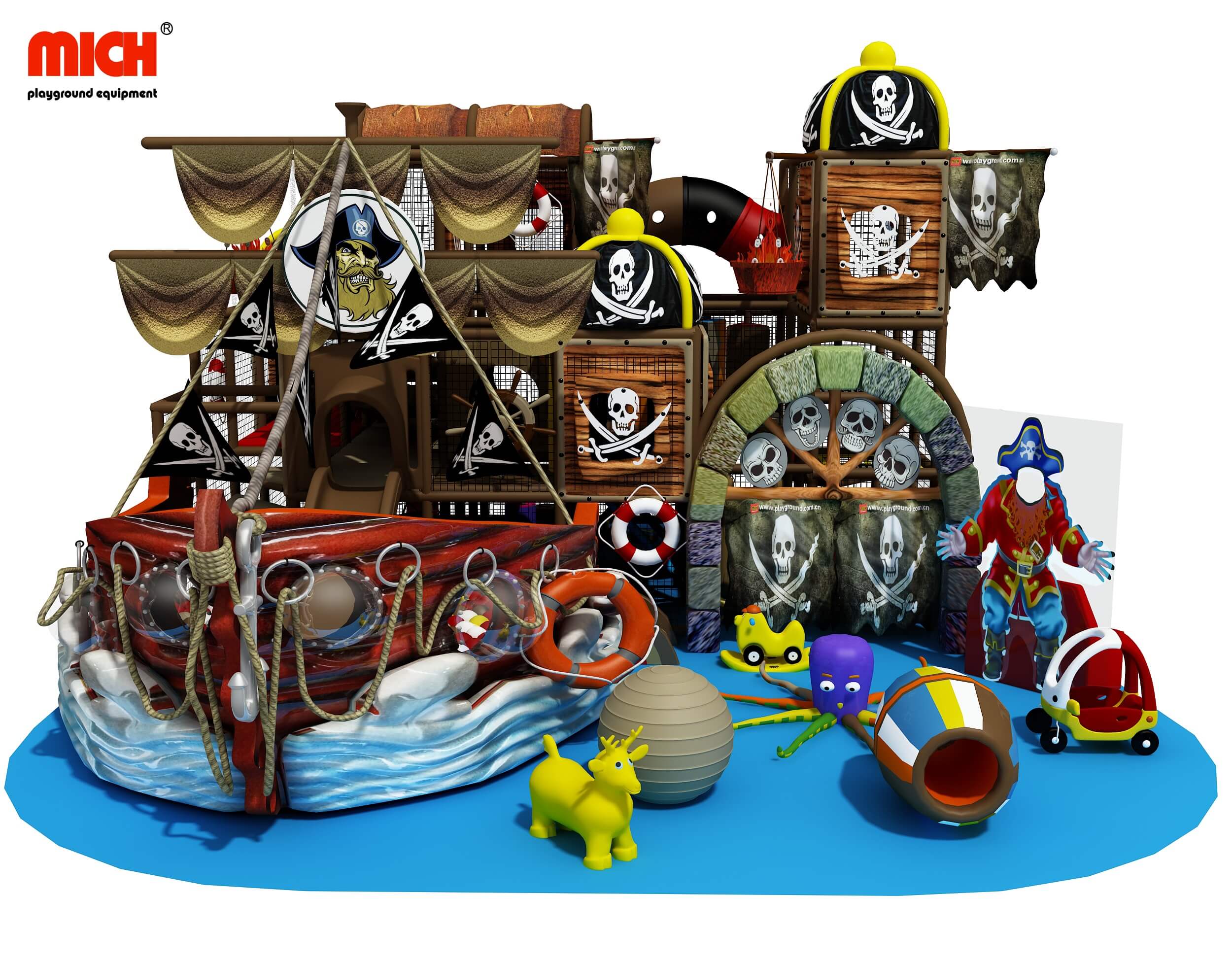
Different factories quantify their minimums using varying metrics. Understanding these solution categories helps you target the right suppliers based on your project scope and facility size. You must align your procurement strategy with the factory's preferred metric.
Most turnkey project manufacturers require a minimum footprint. This typically ranges from 50 to 100 square meters. This metric ensures enough structural volume to justify the custom layout and structural integrity testing. A multi-level play frame requires a certain footprint to safely incorporate staircases, slides, and structural supports. You cannot build a safe three-level structure in a 10-square-meter corner.
Area-based minimums also account for the density of play events. A 100-square-meter frame packed with interactive panels, web crawlers, and spiral slides generates more manufacturing value than a sparse layout. Factories use the square meter metric as a baseline, assuming a standard density of play features. If you request a very sparse layout, they might increase the minimum area requirement.
Some factories bypass size requirements in favor of a minimum financial spend. This approach provides flexibility for buyers mixing different product categories. You might combine a small soft play area with trampoline park elements, ninja courses, or interactive digital games. As long as the total invoice meets the factory's financial threshold, they process the order.
This method works well for family entertainment centers building diverse attractions. You can source your toddler area, main play frame, and climbing walls from one vendor. The combined value easily clears the financial MOQ. It simplifies your logistics and gives you more leverage during negotiations.
Purchasing standalone items often triggers high unit MOQs. Items like a single ball pit, a replacement slide, or loose soft play blocks are treated as wholesale commodities. Factories produce these items in large batches. Ordering a single replacement part from a new supplier is rarely feasible. You typically need to order 50 or more units to initiate a production run.
If you only need a few replacement parts, you must rely on your original manufacturer. They hold your design files and can sometimes slip your small request into a larger production run. Sourcing standalone components from a new factory usually results in mismatched colors and incompatible connection points.
Some suppliers cater specifically to new businesses by offering pre-packaged, low-MOQ kits. These small 20–30 square meter setups lower the barrier to entry for commercial indoor playground startups, cafes, and waiting rooms. Because these designs are pre-engineered and utilize standardized components, the factory produces them efficiently without the overhead of custom drafting.
These packages often ship quickly because the factory keeps the core components in stock. You sacrifice custom theming, but you gain speed and lower upfront costs. This is a practical route for businesses where the playground is an amenity rather than the primary revenue driver.
Balancing unique brand identity against procurement speed and cost is a daily challenge. The level of customization you demand directly impacts the minimum order the factory will accept. You must decide where to allocate your budget.
| Feature | Pre-Engineered Modular Systems | Bespoke Theming and Layouts |
|---|---|---|
| Design Flexibility | Standardized grid systems, stock colors | Custom fiberglass, unique IP, non-standard heights |
| MOQ Impact | Generally lower | Significantly higher |
| Lead Time | Fast production cycle | Extended production cycle |
| Best Application | Daycares, restaurants, small franchises | Large FECs, destination theme parks |
Modular systems utilize standardized grid layouts, pre-cast plastic molds, and stock color palettes. The MOQ impact is generally lower because factories hold these components in inventory or run them alongside other larger orders. This approach fits fast-casual restaurants, waiting rooms, daycare centers, or small franchise rollouts with strict budget caps.
You select from a catalog of pre-designed modules. The engineering is already complete. The safety testing is already documented. The factory simply pulls the parts from the warehouse and stages them for shipping. This drastically reduces the friction of overseas procurement.
Bespoke projects feature custom fiberglass elements, unique thematic designs, and non-standard structural heights tailored to a specific building. The MOQ impact is significantly higher. This requires dedicated mold creation, custom safety testing, and specialized fabrication. These projects suit large-scale Family Entertainment Centers and destination theme parks.
Custom fiberglass work is labor-intensive. Sculptors carve the initial shape from foam. Workers apply layers of fiberglass and resin. Painters add the final thematic details. You cannot order a single custom fiberglass mascot without paying a massive premium. Factories require a large overall project volume to justify the setup costs for these bespoke elements.
Filtering vendors based solely on their willingness to accept a small order introduces massive operational risk. You must evaluate suppliers based on risk mitigation and long-term operational viability. A low MOQ means nothing if the equipment falls apart in six months.
Do not accept self-certified claims. Require verifiable third-party testing reports from reputable organizations like TUV Rheinland or SGS. These reports must prove compliance with ASTM F1918-12 for the US market or EN1176/EN1177 for Europe. Check for fire-retardant certifications on all PVC materials, foam padding, and safety netting. An uncertified playground is an uninsurable liability.
Inspect the certificates closely. Ensure they apply to the specific materials and designs you are purchasing, not just a generic factory audit. Call the testing laboratory to verify the certificate number. Forged documents are common, and you bear the ultimate responsibility for safety compliance in your facility.
Demand precise specifications for all raw materials. For the structural frame, insist on galvanized steel pipe thickness of at least 2.0mm to 2.5mm for commercial use. Verify the use of LLDPE for all molded plastics to ensure durability and fade resistance. Assess the density of EVA foam mats and the denier count of the PVC covers used for soft padding.
Establish strict quality checkpoints before the cargo leaves the port. Use independent inspection services to verify material compliance, structural dimensions, and component counts before authorizing final payment. This ensures that low-MOQ orders are not manufactured with sub-standard or leftover scrap materials.
The inspector should assemble a portion of the play frame at the factory. This trial assembly verifies that the steel pipes align correctly and the connection brackets fit tight. Finding a misaligned structural component during installation at your facility causes massive delays. Catch these errors on the factory floor.
Evaluate the availability of replacement parts. A reliable China Indoor Playground Manufacturer provides a clear warranty, typically covering soft parts for a few years and steel frames for much longer. They must offer a streamlined process for ordering replacement wear-and-tear items without enforcing full-project MOQs on existing clients.
Ask the manufacturer about their parts inventory system. Do they keep your specific design files on record? If a custom slide cracks three years from now, can they pull the file and mold a replacement? A vendor who cannot guarantee long-term parts support is not a viable partner for a commercial facility.
Securing favorable terms without compromising your project scope requires strategic negotiation. Use these tactics to manage factory constraints effectively. You must present your project in a way that appeals to the factory's operational goals.
Negotiate a sample order or a small-scale pilot project. Propose building a standalone toddler play area to assess material quality, communication efficiency, and structural integrity before committing to a full-scale commercial installation. Many factories waive standard MOQs for a paid sample if they believe it will lead to a larger contract.
Treat the trial order as a stress test for the vendor. Monitor their communication speed, their attention to detail in the drafting phase, and their adherence to the production schedule. If they struggle with a small toddler area, they will fail on a massive multi-level play frame.
Understand the tipping points for customization. Ask the factory for the exact MOQ needed to add custom branding, logos, or specific color schemes to their standard pre-engineered components. Agreeing to use stock plastic colors while customizing the PVC padding colors allows you to bypass higher MOQs associated with custom plastic molding.
PVC padding is cut and sewn to order. Changing the vinyl color adds very little overhead to the production process. Plastic molding requires changing the raw material powder and cleaning the mold. Focus your customization efforts on the soft materials to keep your order volume requirements manageable.
Combine your indoor playground china order with other facility needs. Source your rubber flooring, seating, party room furniture, and arcade machines from a single comprehensive supplier or through a dedicated sourcing agent. Pooling these items helps you meet financial MOQs and fills shipping containers more efficiently.
Shipping empty air inside a container wastes money. Consolidating your purchases ensures you maximize the cubic meter (CBM) capacity of the shipping container. A sourcing agent can coordinate deliveries from multiple factories to a single warehouse, loading everything into one container bound for your facility.
If you are opening multiple locations, negotiate a Master Service Agreement. Commit to an annual volume across several sites to waive per-order MOQs for individual locations. This allows you to standardize your equipment across the franchise while drawing down inventory as each new location secures its lease.
The factory gets a guaranteed pipeline of work. You get consistent equipment and favorable pricing without having to order everything at once. This strategy requires strong financial backing and a clear expansion timeline to convince the factory to agree to the terms.
The factory invoice is only a fraction of your total investment. Calculating the total landed cost is essential for accurate budgeting. Ignoring these variables leads to severe cash flow problems during the final stages of your project.
Shipping commercial playground equipment requires Full Container Loads, typically utilizing 20ft or 40ft High Cube containers. Shipping Less than Container Load for small orders often negates any cost savings due to high volumetric weight charges and increased risk of damage during transit. You must factor in ocean freight rates, port handling charges, and inland transportation to your facility.
Calculate the specific HS codes for playground equipment to determine local import taxes and potential trade tariffs. Import duties vary wildly depending on your country and current trade agreements. Work with a licensed customs broker to accurately forecast these expenses before placing your order. Do not guess on import duties.
Factor in the cost of installation labor. You must hire local certified installers or fly out the manufacturer's installation team. If using the factory's team, you are responsible for their visas, international flights, local accommodation, and daily per diems. Improper installation voids warranties and fails safety inspections. Professional assembly is a mandatory expense.
Local permitting and inspection fees also add to the total landed cost. Your municipality will require structural engineering stamps and fire marshal inspections. Budget for these administrative costs early in the planning phase. The equipment must pass these local checks before you can open your doors to the public.
Navigating the MOQ for indoor playground equipment requires shifting focus from unit pricing to total project scale. Factories enforce minimums to maintain safety, structural integrity, and economic viability. Eliminate vendors who offer suspiciously low MOQs on custom designs. Prioritize manufacturers who transparently link their MOQs to square footage, engineering requirements, and international safety standards.
A: Generally, no. Most manufacturers focus on turnkey projects. Single pieces are usually restricted to high-volume wholesale orders, though replacement parts are available for existing clients.
A: Costs vary widely based on density, theming, and material selection. The equipment cost is only the baseline. You must calculate ocean freight, import duties, customs clearance, and professional installation labor to determine the final required budget.
A: Top-tier manufacturers engineer their products to meet strict ASTM and EN standards. The buyer is responsible for verifying third-party testing certificates before purchase.
A: Production typically takes 20 to 45 days after design approval. Ocean freight adds an additional 30 to 45 days depending on the destination port and customs clearance times.
A: Yes. Reputable manufacturers provide detailed 3D installation manuals and can dispatch professional installation engineers to your site, provided you cover their travel and accommodation expenses.