- All
- Product Name
- Product Keyword
- Product Model
- Product Summary
- Product Description
- Multi Field Search

Views: 0 Author: Site Editor Publish Time: 2026-10-26 Origin: Site
Regulatory mandates and community expectations require commercial and educational play spaces to provide genuinely inclusive environments. Moving beyond bare-minimum accessibility is mandatory. Planners must create spaces where children of all abilities engage actively and equally. Facility managers, school districts, and municipal planners face a distinct challenge. They must balance strict safety standards, such as ADA compliance, with tight budget constraints when procuring large-scale play structures.
Sourcing from international manufacturers offers a practical strategy to scale playground projects effectively. Buyers need a robust framework to evaluate equipment for developmental value, safety compliance, and long-term durability. This guide outlines how to select the right structures, verify factory credentials, and ensure seamless site integration. You will learn how to identify true inclusive features and avoid common compliance pitfalls during installation.
An inclusive playground succeeds when children of all abilities play simultaneously in the same space. True inclusivity extends far beyond basic wheelchair access. Physical inclusivity involves integrating ramps, transfer stations, and flush transitions. These elements allow children with mobility devices to navigate the core play structures independently. Equipment must support continuous movement without creating dead ends or isolated accessible zones. When pouring concrete footings for these ramps, contractors must ensure a maximum running slope of 1:12 to meet ADA guidelines.
Sensory inclusivity targets children who process environmental stimuli differently. Effective designs incorporate tactile inputs, auditory elements, and high-contrast colors for visual impairment. Cognitive inclusivity provides predictable layouts and cozy domes for overstimulation relief. Therapist-approved designs ensure equipment supports developmental milestones. Structures must facilitate vestibular tracking, proprioceptive input, and motor skill planning for early childhood and toddlers. Selecting the right Kids Outdoor Playground Equipment ensures these diverse needs are met seamlessly on site.
Site preparation plays a massive role here. If the sub-base grading is off by even a few degrees, the flush transitions fail. Installers must use laser levels during the initial dirt work. Proper drainage prevents water pooling around sensory stations, which would otherwise block access for mobility devices.
Facility managers must weigh the cost-benefit of retrofitting existing traditional play spaces against developing a completely new layout. Retrofitting involves integrating modular inclusive components into an older footprint. This approach works well when the existing foundation and safety surfacing remain compliant. Adding accessible freestanding sensory tables or inclusive swings upgrades older infrastructure within tight budgetary constraints.
Ground-up designs offer complete control over site routing and equipment integration. Planners can ensure all pathways meet exact ADA slope requirements from the start. When retrofitting, buyers must choose compatible add-on elements that match existing post sizes and deck heights. Careful measurement and coordination with the manufacturer prevent installation delays and ensure structural integrity. You cannot simply bolt a new inclusive ramp onto a 15-year-old rusted steel post. The structural load capacities will not align.
Contractors must core-drill existing concrete pads to install new footings for retrofit components. This requires ground-penetrating radar to avoid striking existing utilities. Ground-up builds avoid this headache entirely. You trench your drainage, set your sonotubes, and pour your footings in one continuous phase.
Evaluating equipment requires a standardized framework. The seven principles of inclusive design provide a reliable lens for assessment. Fair use ensures the equipment provides the same means of use for all users. Flexibility accommodates a wide range of individual preferences and abilities. Simple and intuitive use means children understand how to interact with the structure immediately, regardless of cognitive level.
Perceptible information requires the design to communicate necessary operating cues effectively. Tolerance for error minimizes hazards and adverse consequences of unintended actions. Low physical effort allows children to use the equipment efficiently and comfortably with minimum fatigue. Finally, appropriate size and space for approach ensure children using mobility devices can reach, manipulate, and use the play features.
Applying these principles in the field means checking reach ranges. If a tactile panel sits 48 inches off the poured rubber surface, a child in a wheelchair cannot reach the top gears. Installers must verify the finished surface elevation before setting the final post heights. A miscalculation in the sub-base gravel thickness will throw off every reach range on the playground.
Motion equipment provides critical vestibular stimulation. Adaptive swings feature high-backed, molded bucket seats with secure harnesses. These seats support children with low core strength, allowing them to experience swinging safely. Flush-mounted merry-go-rounds and spinners accommodate mobility devices directly. Children can roll onto the platform without needing a transfer, promoting immediate peer interaction.
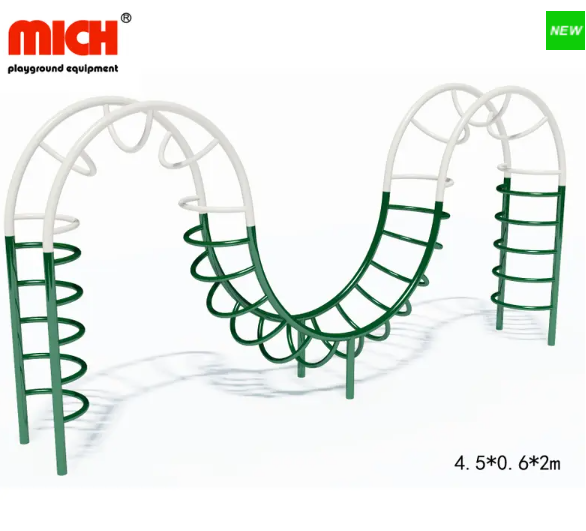
Inclusive climbing structures focus on accessibility and varied challenge levels. Low-profile, high-traction rope climbers provide secure grips. Designs often include transfer platforms to support upper-body-only climbing. These features allow children with lower-body mobility challenges to pull themselves up and engage with elevated play components alongside their peers.
Installing flush-mounted spinners requires exact pit dimensions. The concrete pit must house the bearing assembly while allowing the top platform to sit perfectly level with the surrounding safety surfacing. If the pit drainage fails, the bearings will rust out within a single season. Always pipe the spinner pit directly into the site's main stormwater drain.
Freestanding play stations deliver concentrated sensory experiences. Sand and water tables designed at wheelchair-accessible heights allow children to pull up and engage directly. These stations promote fine motor skills and tactile exploration. Outdoor musical instruments, such as chimes and drums, provide auditory feedback. Interactive gear panels require minimal physical force to operate, making them accessible to children with limited upper-body strength.
Creative and sensory-rich elements encourage peer-to-peer social interaction. Elevated sandbox stations and built-in sidewalk chalk surfaces create collaborative zones. These ground-level activities ensure children who cannot access elevated decks still participate in meaningful, shared play experiences. Sourcing high-quality china outdoors toys for kids allows facilities to integrate these diverse sensory stations efficiently.
When mounting musical instruments, use tamper-proof stainless steel hardware. High-vibration components will rattle standard zinc bolts loose in weeks. Apply thread-locking fluid to every connection point during assembly. Position these auditory stations away from quiet zones to prevent sensory overlap and overstimulation.
Imaginative play fosters cognitive development and social skills. Ground-level playhouses and storefront panels encourage parallel and cooperative play. Children with varying mobility levels can interact across these panels, taking on different roles in imaginative scenarios. These structures do not require climbing or complex physical navigation, making them universally accessible.
Companion structures amplify social inclusion. Extra-wide double slides allow a child to slide side-by-side with a peer, parent, or therapist. This shared experience builds confidence and ensures children requiring assistance can still enjoy dynamic motion equipment. Companion seating on spring riders and seesaws further supports collaborative play.
Double slides require wider fall zones. The safety surfacing must extend further out from the slide exit to accommodate the increased momentum of two users. Verify the critical fall height (CFH) rating of the surfacing matches the highest deck elevation connected to the slide. Never cut corners on the impact attenuation pads at the slide exit.
Commercial deployment requires strict adherence to international safety standards. Buyers must demand equipment certified to ASTM F1487 (USA) or EN1176 (Europe). Manufacturing facilities should hold ISO 9001 and ISO 14001 certifications, ensuring consistent quality control and environmental management. These standards dictate critical safety metrics, including head entrapment hazards and structural integrity.
Relying on self-certified factory documents introduces severe liability risks. Buyers must verify third-party testing reports from recognized bodies like TUV Rheinland or SGS. Cross-referencing certification numbers directly with the issuing agency confirms the documents are current and valid for the specific product lines being purchased.
Field inspectors will use head entrapment probes on every gap in the structure. If a custom panel from an unverified supplier fails the probe test, the entire playground fails inspection. You will have to rip out the non-compliant panels and fabricate replacements, delaying the grand opening by months.
Material selection directly impacts maintenance schedules and hardware longevity. Commercial-grade galvanized steel provides the necessary structural support for high-capacity play structures. UV-stabilized rotational molded plastics resist fading and cracking in extreme weather. Non-toxic, lead-free powder coatings protect metal surfaces from rust while ensuring child safety.
Extreme weather environments demand specific material considerations. Coastal areas require enhanced corrosion resistance, often necessitating marine-grade hardware. High-heat regions benefit from lighter-colored plastics and shade structures to prevent contact burns. Evaluating these material specifications ensures the equipment remains safe and functional over its intended lifespan.
Check the wall thickness of the steel posts. A 5-inch O.D. post should have a minimum 11-gauge wall thickness for commercial applications. Anything thinner will flex under heavy loads, causing the powder coating to crack and flake. Once the coating breaches, moisture penetrates, and structural rust begins immediately.
Implementing a standardized verification framework prevents critical oversights during procurement. Use the following checklist to evaluate commercial-grade equipment.
| Evaluation Criteria | Verification Focus | Field Inspection Method |
|---|---|---|
| 1. Material Safety | Verification of lead-free, non-toxic, and hypoallergenic surfaces. | Review factory material safety data sheets (MSDS) before shipping. |
| 2. Accessibility Compliance | Structural checks for transfer heights, clear ground space, and reach ranges. | Measure installed deck heights against finished surfacing elevations. |
| 3. Structural Load Capacity | Verified weight limits for multi-user and companion use. | Check post footing depths and concrete PSI ratings. |
| 4. Play Value Balance | Equitable mix of physical, sensory, and quiet-play zones. | Review site plan zoning and traffic flow patterns. |
| 5. Maintenance Predictability | Low-wear connections and tamper-resistant hardware. | Inspect bolt threads and bearing seals during assembly. |
Procurement teams must choose between pre-designed inclusive structures and custom-engineered layouts. Off-the-shelf products offer faster lead times and lower initial costs. These standard configurations come with pre-verified safety certifications, streamlining the approval process. However, they may not perfectly match unique site dimensions or specific community needs.
Custom-engineered layouts provide superior site integration. Planners can tailor the equipment to fit irregular footprints and target specific developmental goals. While custom designs require longer lead times and higher engineering costs, they deliver a highly optimized play environment. Buyers must assess the manufacturer's engineering team to ensure custom designs still meet all structural and safety standards.
Request the raw CAD files for any custom design. Your local civil engineer needs these files to plot the exact footing locations. If the manufacturer only provides flat PDF renderings, your installation crew will have to guess the post spacing in the field. This always leads to misaligned decks and forced connections.
Vetting suppliers requires a rigorous audit framework. Start by requesting comprehensive video audits of the production floor. Observe the welding processes, powder coating lines, and assembly stations. Review their raw material sourcing documentation to confirm steel gauge and plastic density specifications. A reliable China Playground Manufacturer will maintain transparent records of their supply chain.
Analyze the manufacturer's in-house testing laboratories. Verify they conduct regular drop tests, load-bearing tests, and salt spray corrosion tests. Request documentation showing how they handle batch testing and defect isolation. Strong internal QA processes drastically reduce the risk of receiving non-compliant or defective components on site.
Look closely at the weld seams in the audit videos. You want to see smooth, continuous robotic welds on the main structural joints. Hand-welded joints often contain slag inclusions and porosity, which create weak points. If the factory floor lacks automated welding cells, the structural consistency of your equipment is at risk.
Overseas procurement introduces specific logistical risks. Port congestion, customs holds, and shipping container shortages can extend lead times significantly. Weather events and regional holidays also impact production and transit schedules. Failing to account for these variables leads to delayed site openings and contractor scheduling conflicts.
Mitigate these risks by buffering project timelines by 20 to 30 percent. Require staggered shipment schedules for phased installations. This approach allows site preparation and foundation work to proceed while waiting for final equipment delivery. Maintain clear communication with the freight forwarder to track container progress and anticipate customs clearance requirements.
Always require a detailed packing list matched to the bill of lading. When the container arrives on site, your crew must inventory every single bolt and clamp before the truck leaves. Missing hardware from an overseas shipment will halt your installation for weeks while you wait for air-freighted replacements.
The most critical implementation risk involves safety surfacing. Even the most inclusive equipment fails ADA compliance if installed on non-compliant surfacing. Loose materials like sand or engineered wood fiber degrade over time and impede wheelchair navigation. Unitary surfaces, such as poured-in-place (PIP) rubber or bonded rubber mulch, provide the necessary stability and impact attenuation.
Mitigate surfacing risks by mandating strict coordination. The overseas manufacturer must provide exact footprint specifications and fall zone dimensions. Share these documents with local certified playground safety inspectors (CPSI) prior to pouring foundations. Verifying post hole depths and deck heights against the surfacing thickness ensures the final transfer heights remain ADA compliant.
PIP rubber requires specific temperature and humidity conditions to cure properly. If your installation schedule pushes into late fall, the binder will not set, and the surface will crumble. Coordinate the equipment delivery so the surfacing contractors have a clear weather window to pour the rubber base and wear courses.
A: Truly inclusive equipment integrates physical, sensory, and cognitive play elements accessible to all children. It goes beyond wheelchair ramps by providing tactile inputs, auditory features, and ground-level interactive panels, ensuring children of all abilities can actively play together in the same space.
A: Yes, safety depends on verified adherence to international standards like ASTM F1487 and EN1176. Buyers must demand third-party testing reports from recognized agencies like TUV or SGS to confirm structural integrity and material safety, regardless of the country of origin.
A: Request the official certification documents and locate the certificate number. Contact the issuing body, such as TUV Rheinland or SGS, directly through their official website or verification portal to confirm the certificate is valid, current, and applies to the specific product line.
A: An accessible playground allows a child with a disability to enter and navigate the space, often meeting minimum ADA requirements. An inclusive playground ensures that once inside, the child can actively engage with the equipment and play alongside their peers without barriers.
A: Inclusive playgrounds require unitary safety surfacing to support mobility devices. Poured-in-Place (PIP) rubber or bonded rubber mulch are ideal, as they meet ADA wheelchair navigation requirements while providing necessary impact attenuation for fall zones.
A: You can adapt existing spaces through modular retrofits. By adding custom components like freestanding sensory tables, inclusive swings, or ground-level music stations from a verified manufacturer, you can significantly improve inclusivity without the cost of a complete rebuild.
A: Importing typically takes 8 to 16 weeks. This timeline accounts for manufacturing, overseas freight, customs clearance, and final delivery to the site. Buyers should buffer their project schedules by 20 to 30 percent to accommodate potential logistics delays.