- All
- Product Name
- Product Keyword
- Product Model
- Product Summary
- Product Description
- Multi Field Search

Views: 1 Author: Site Editor Publish Time: 2026-06-16 Origin: Site
Commercial real estate developers, municipal park planners, school administrators, and family entertainment centers face a strict economic reality. You must maximize capital expenditure while sourcing high-quality infrastructure globally. Navigating the fragmented overseas manufacturing market presents a significant challenge. Buyers struggle to distinguish between low-tier consumer products and certified commercial-grade infrastructure. These structures must meet strict domestic safety, durability, and liability standards.
This guide provides a technical framework for categorizing commercial structures. You will learn how to evaluate material specifications and verify eco-friendly properties. We will explore the types of structures available from a reputable China Playground Manufacturer. You will also discover practical strategies to mitigate import risks, manage installation logistics, and ensure total compliance with local safety regulations.
Establishing clear project parameters prevents costly sourcing mistakes. You must define your operational needs before contacting any factory. A vague inquiry yields inaccurate proposals and mismatched equipment. Professional site planning requires precise measurements and a deep understanding of user demographics.
Establish baseline metrics for your specific project. Calculate your maximum user capacity and target age groups. Differentiate between toddler zones and youth adventure areas. Measure your exact footprint constraints. Account for safety zones and fall clearances around every structure. Estimate your expected daily throughput. High-traffic municipal parks require heavier gauge materials than private residential developments.
Require verifiable documentation for all international standards. Demand proof of ASTM F1487 compliance for US markets. Request EN1176 certificates for European installations. Verify the factory holds an active ISO 9001 quality management certification. Cross-reference all factory certificates directly with third-party testing labs. Contact SGS, Intertek, or TUV Rheinland to validate document authenticity. This verification step prevents fraudulent claims and liability disasters.
You must also ensure that the manufacturer understands local accessibility requirements. In the United States, this means strict adherence to ADA guidelines. Ramps, transfer stations, and ground-level play components must meet specific width and slope ratios. Failing to verify these compliance baselines before manufacturing begins will result in failed local inspections and costly retrofits.
The manufacturing landscape covers every commercial recreation category. Factories specialize in distinct material disciplines and structural types. Understanding these categories helps you select the right manufacturing partner for your specific site requirements.
Factories produce standard modular systems for parks, schools, and residential developments. These systems utilize eco-friendly, food-grade LLDPE for slides, roofs, and interactive panels. Manufacturers use heavy-duty galvanized steel for all structural posts. The standard post diameter for commercial applications is typically 114mm or 89mm. You can specify inclusive and ADA-accessible outdoor equipment. Ramps, ground-level panels, and transfer stations ensure universal access.
Modular designs allow for extensive customization. You can configure multiple decks, bridges, and climbers to fit irregular site dimensions. The rotational molding process used for the plastic components ensures uniform wall thickness. This manufacturing technique prevents weak spots in high-stress areas like slide runouts and tunnel junctions.
You can source essential standalone elements to complement large structures. Factories supply commercial-grade swings, heavy-duty see-saws, rotary merry-go-rounds, and spring riders. Quality Playground Equipment requires robust ground anchoring and heavy-duty bearings. Manufacturers also produce specialized commercial inflatable structures. High-turnover recreational events often utilize these heavy-duty bouncy castles.
Standalone equipment often experiences the highest volume of continuous use. Swing set top beams must utilize thick-walled galvanized steel to prevent bowing. Bearings in merry-go-rounds require sealed, maintenance-free housings to withstand sand, dirt, and moisture. Always specify anti-wrap swing hangers to reduce maintenance intervals.
Custom soft play areas dominate the indoor recreation market. Components include massive ball pits, multi-level climbing frames, and dedicated toddler zones. Modern facilities integrate high-throughput attractions. You can source commercial trampolines, ninja warrior courses, and interactive digital play elements. These indoor systems require precise spatial planning and custom engineering.
Indoor structures rely on a grid of galvanized steel pipes wrapped in high-density foam. The structural integrity of a multi-level soft play center depends on the thickness of these pipes and the quality of the cast iron junction clamps. Netting must be tightly woven and securely fastened to prevent entrapment hazards.
The market for eco-friendly, natural play structures continues to grow. These designs encourage imagination, sensory exploration, and creative play. Factories utilize specific timber varieties like Robinia, treated pine, and larch. You must specify chemical-free treatments. These treatments ensure weather resistance, rot prevention, and splinter reduction without toxic runoff.
Wooden structures require specialized hardware to accommodate the natural expansion and contraction of the timber. Stainless steel through-bolts and heavy-duty washers prevent the wood from splitting. Ground-contact posts must utilize steel anchors to keep the timber elevated above soil moisture, significantly extending the lifespan of the installation.
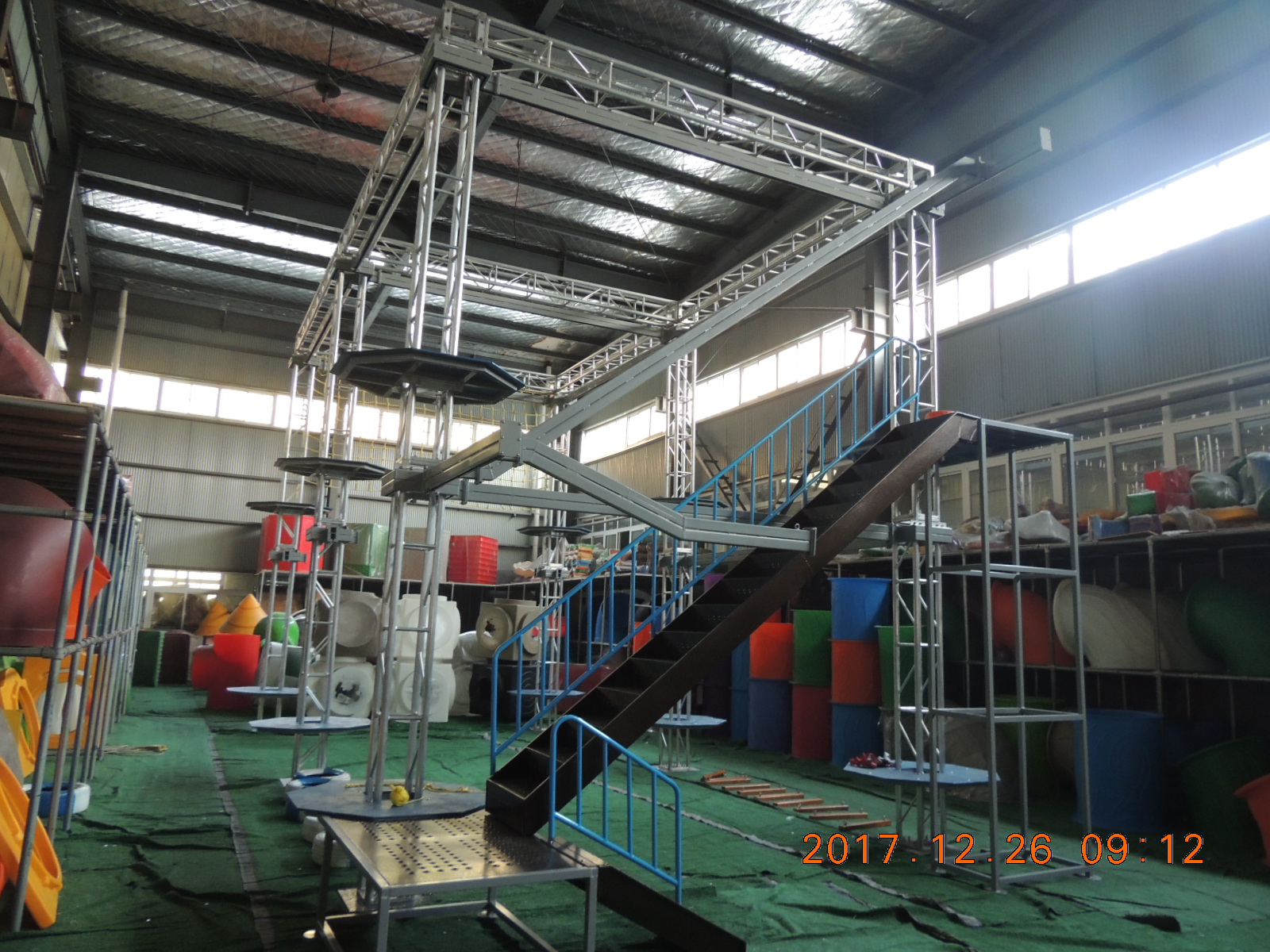
Large-scale installations cater to older youths and adults. Options include multi-tier rope courses, giant spiral tube slides, and zip lines. Factories also build custom-themed amusement structures. These high-liability installations demand rigorous structural engineering. You must require dynamic load calculations and specialized safety netting.
High-thrill attractions often require custom fabrication. Spiral tube slides exceeding three meters in height need reinforced support columns and precise flange alignments to prevent friction burns. Rope courses demand marine-grade steel cables wrapped in durable nylon to withstand continuous abrasion and heavy dynamic loads.
Material specifications dictate the lifespan of your installation. Never accept generic material descriptions on a proforma invoice. Demand exact technical specifications for plastics, metals, and padding. Rigorous material vetting prevents premature fading, rusting, and structural failure.
Linear Low-Density Polyethylene (LLDPE) offers superior structural integrity. It provides excellent UV resistance and colorfastness. LLDPE serves as an eco-friendly, non-toxic, and highly recyclable raw material. It outperforms High-Density Polyethylene (HDPE) in complex rotational molding. Specify the inclusion of anti-static and anti-UV stabilizers in the resin mix.
The wall thickness of rotationally molded LLDPE components should average 6mm to 8mm. Thinner walls will warp under direct sunlight and crack under heavy impact. Request material test reports that confirm the tensile strength and environmental stress crack resistance of the specific resin batch used for your order.
Rust prevention remains critical for outdoor longevity. Demand hot-dip galvanized steel for all structural pipes. The ideal thickness for commercial steel pipes ranges from 2.0mm to 2.5mm. Require high-grade, non-toxic, and lead-free powder coating processes. The coating must withstand salt spray testing and extreme weather fluctuations.
The powder coating process requires meticulous surface preparation. Factories must sandblast the galvanized pipes to create a textured surface for the powder to adhere. The baking process must occur at precise temperatures to cure the resin properly. Improper curing leads to flaking, peeling, and rapid oxidation of the underlying steel.
Indoor materials must meet strict commercial standards. Specify high-density EPE or PU foam for impact absorption. Require heavy-duty PVC tarpaulin with a minimum 0.55mm thickness. Strict adherence to fire retardancy standards is mandatory. Verify compliance with EN71 or NFPA 701 fire safety regulations.
The stitching on PVC covers must utilize heavy-duty nylon thread. Double-stitched seams prevent tearing in high-traffic areas. The EPE foam used for pipe wrapping should have a minimum thickness of 15mm to provide adequate impact protection. Inferior foam will compress over time and lose its shock-absorbing properties.
Hardware failure leads to structural collapse. Highlight the critical role of 304 or 316 stainless steel hardware. Use tamper-resistant fasteners to prevent vandalism. High-grade hardware prevents corrosion and ensures long-term structural stability.
Galvanized bolts will rust rapidly in coastal environments. Always specify 316 marine-grade stainless steel if your installation site is within five miles of saltwater. All exposed nuts must utilize plastic dome caps to prevent clothing entanglement and protect the threads from weather exposure.
| Material Component | Commercial Specification | Primary Application | Key Benefit |
|---|---|---|---|
| Structural Posts | Galvanized Steel (2.0mm - 2.5mm) | Outdoor Play Structures | Maximum load bearing and rust resistance. |
| Slides & Panels | Food-Grade LLDPE (6mm - 8mm) | Outdoor & Indoor Structures | UV resistant, non-toxic, and recyclable. |
| Indoor Padding | High-Density EPE Foam (15mm+) | Soft Play & Trampolines | Superior impact absorption and shape retention. |
| Indoor Covers | 0.55mm PVC Tarpaulin | Soft Play Frames | Tear resistant, easy to clean, fire retardant. |
| Fasteners | 304/316 Stainless Steel | All Equipment Types | Prevents rust streaks and structural failure. |
| Rope Cables | Marine-Grade Steel Core Nylon | Climbing Nets & Rope Courses | High tensile strength and abrasion resistance. |
Selecting the right factory mitigates project risks. You must look past glossy catalogs and evaluate actual production capabilities. A structured vetting process separates reliable partners from high-risk suppliers. You need a manufacturer capable of executing complex engineering tasks and providing reliable post-sale support.
Establish a structured evaluation matrix based on three core pillars. First, assess product range and depth. Does the factory specialize in your specific niche? Second, demand verifiable certification history. Look for genuine TUV GS marks and ASTM-compliant production lines. Third, evaluate deep customization capabilities. They must deliver bespoke configurations, not just standard catalog models.
Differentiate between trading companies and actual manufacturers. Trading companies add margins and obscure quality control. Request live video tours of the production floor. Hire third-party inspection agencies like SGS or Intertek for factory audits. Review their in-house R&D capabilities and testing equipment.
Evaluate the manufacturer's ability to provide localized 3D renderings. They should supply precise CAD drawings and site adaptations. Discuss the iterative design process. Ensure the final product matches your approved architectural blueprints exactly. A competent factory will adjust designs to fit your exact floor plan.
The design team must understand fall zone calculations. They should provide top-down layout drawings that clearly delineate the required safety surfacing area. If a manufacturer cannot produce detailed DWG files for your local architect to review, you should find another supplier.
Analyze standard warranty expectations for different materials. Expect 10 years on steel posts and 3 years on plastics. Soft play components typically carry a 1-year warranty. Address the reality of claiming warranties internationally. Negotiate a comprehensive spare parts package in your initial container shipment.
Shipping a single replacement plastic panel via air freight costs more than the panel itself. Request extra hardware, touch-up paint, and high-wear items like swing seats and bearings to be included in the main container. This proactive approach minimizes downtime when components eventually wear out.
Importing large infrastructure involves logistical hurdles. Proper planning prevents costly delays at the port. You must manage freight and installation with precision. A delayed container or a botched installation will destroy your project timeline.
Map out your logistics timeline early. Understand the differences between LCL (Less than Container Load) and FCL (Full Container Load) shipping. FCL offers better protection for bulky components. Anticipate seasonal port congestion around major holidays. Work with an experienced freight forwarder to manage customs clearance smoothly.
Playground equipment is bulky and often fills a container by volume long before it reaches the weight limit. Request a detailed packing list and container loading plan from the factory. Ensure they use proper dunnage and strapping to prevent heavy steel posts from crushing plastic components during rough ocean transit.
Installation remains the most significant bottleneck. Compare the risks of using local general contractors versus specialized installers. Specialized installers understand fall zones and compliance codes. Demand highly detailed, English-language installation manuals. Require pre-assembly testing at the factory prior to shipment. Factories should provide photos of the pre-assembled structure.
Site preparation must occur while the equipment is in transit. Excavate the footings, pour the concrete sub-base, and arrange for heavy lifting equipment if necessary. When the container arrives, inventory every component against the packing list before beginning assembly. Missing hardware will halt the entire installation process.
A: Yes, safety depends entirely on specifying and verifying strict compliance with ASTM (US) or EN1176 (Europe) standards. You must demand third-party testing reports rather than relying on the country of origin alone.
A: A reputable commercial manufacturer should possess ISO 9001, ISO 14001, TUV GS mark, EN1176, and ASTM F1487 certifications.
A: Expect a realistic timeline of 15-30 days for production. You should add 30-45 days for ocean freight, customs clearance, and local transit.
A: Yes, leading commercial manufacturers utilize eco-friendly, food-grade LLDPE, non-toxic powder coatings, and sustainably sourced wood. You must explicitly detail these specifications in your purchase contract.
A: Some major manufacturers offer to dispatch engineers to your site for an extra fee. Most provide detailed CAD manuals and video guides for local certified playground installers to execute safely.
A: Yes, custom design to fit specific dimensions, ceiling heights, and thematic preferences is standard practice for professional manufacturers.
A: Yes, most commercial manufacturers offer a complete product range of standalone and ancillary equipment to complement major play structures.