- All
- Product Name
- Product Keyword
- Product Model
- Product Summary
- Product Description
- Multi Field Search

Views: 0 Author: Site Editor Publish Time: 2026-11-15 Origin: Site
Municipalities, educational institutions, and commercial developers face a persistent challenge: delivering highly engaging, rigorously safe play spaces while operating under strict capital expenditure limits. Balancing long-term structural durability with bespoke, thematic designs often stretches procurement budgets to their breaking point. Sourcing commercial play structures globally provides a definitive solution to this problem.
Evaluating overseas manufacturing hubs has shifted from a simple cost-saving measure to a comprehensive value-engineering strategy. By accessing established supply chains, buyers can leverage economies of scale to procure advanced, modular play environments that meet stringent international safety standards. This guide details the strategic advantages, evaluation criteria, and risk mitigation strategies necessary for successfully importing commercial play structures. You will learn how to navigate factory audits, enforce material specifications, and manage international logistics to ensure your next installation is safe, durable, and delivered on schedule.
The concentration of raw material suppliers near major manufacturing hubs, such as Wenzhou and Guangzhou, creates a highly efficient production ecosystem. Factories have immediate access to industrial-grade steel, specialized plastics, and advanced powder coatings. This localized supply chain drastically reduces production bottlenecks and lowers overall manufacturing costs. Buyers benefit from these efficiencies, allowing them to procure expansive, commercial-grade china outdoors toys for kids without compromising on structural integrity or material quality.
When a factory sits within a ten-mile radius of its steel tube supplier, plastic resin distributor, and hardware manufacturer, the logistics of assembling complex, multi-component play structures become streamlined. This proximity means that custom orders do not suffer from long material acquisition delays. If a specific gauge of galvanized steel is required for a heavy-duty swing set frame, the factory can source it same-day. This level of supply chain integration is difficult to match in regions where raw materials must be shipped across the country before manufacturing even begins.
Furthermore, this ecosystem supports a massive skilled labor pool. Welders, rotational molding technicians, and powder coating specialists in these hubs possess years of specific experience in playground manufacturing. Their expertise translates directly into better weld penetration on structural joints, more uniform wall thickness on plastic slides, and superior adhesion of protective coatings. The result is a product that withstands heavy commercial use and severe weather conditions.
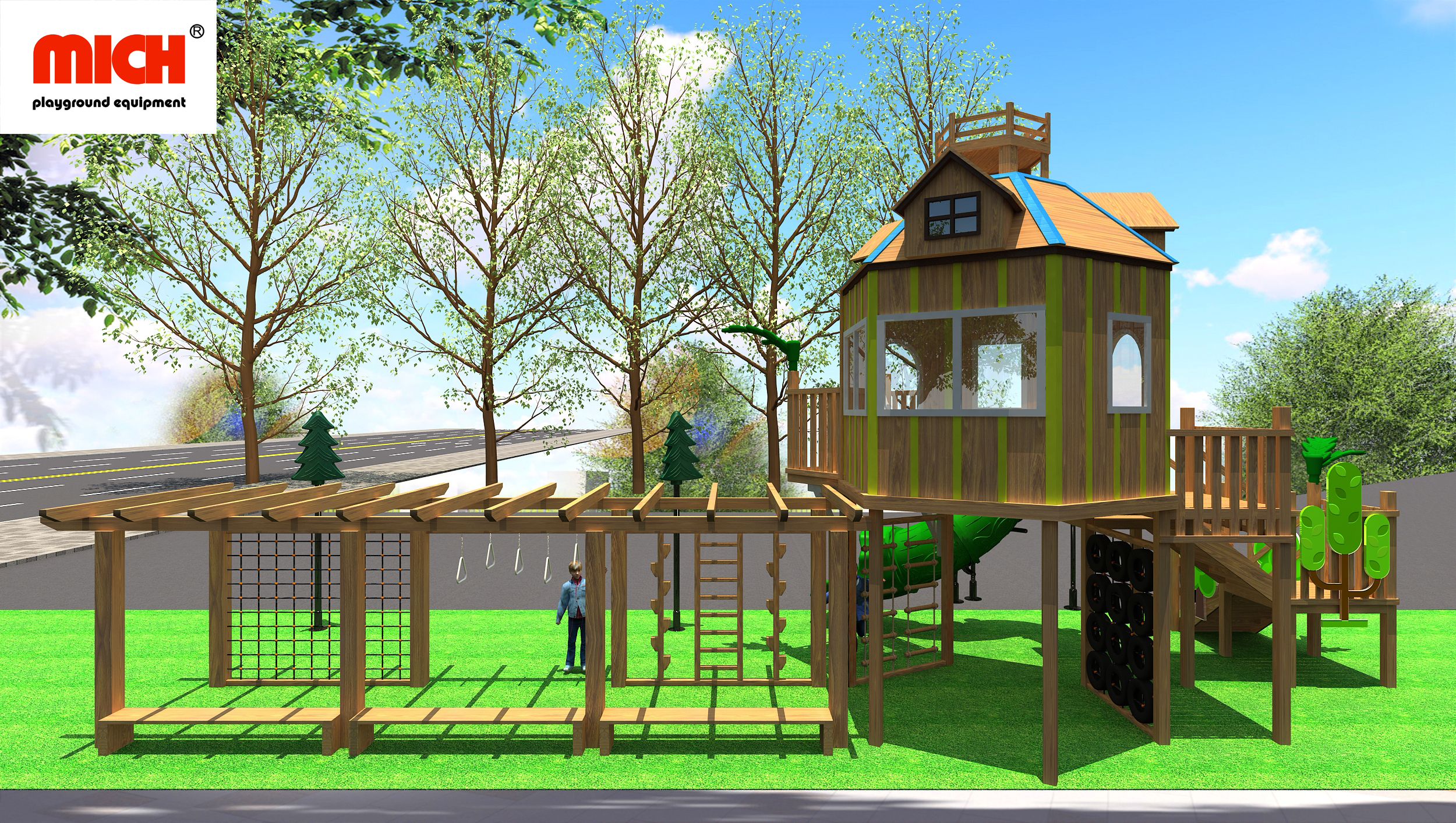
Modern commercial play spaces have evolved far beyond standard off-the-shelf products. Leading facilities now engineer highly customizable, modular play structures designed to fit specific spatial constraints and topographical challenges. Capabilities in thematic design enable the creation of nature-inspired environments, futuristic climbing towers, and inclusive play features accessible to children of all physical abilities. These modern designs integrate interactive elements that stimulate children's senses, inspire active physical play, and foster early cognitive development through problem-solving challenges.
Modular engineering allows buyers to mix and match components to suit their exact site dimensions. If a municipal park has a narrow, elongated footprint, the manufacturer can configure a linear play structure that maximizes the available space without encroaching on required safety fall zones. This flexibility extends to the aesthetic design as well. Custom color palettes can be matched to school colors or corporate branding, and thematic elements like pirate ships, space stations, or jungle treehouses can be integrated seamlessly into the structural framework.
Sensory play is another area where overseas manufacturers excel. Modern structures incorporate musical panels, tactile climbing walls, and visually stimulating gear panels. These elements are not just add-ons; they are engineered into the core design to ensure that children of all abilities, including those with sensory processing differences, can engage with the equipment. This inclusive approach to design ensures that the playground serves the entire community effectively.
Consistent quality across large commercial orders requires advanced manufacturing technology. Modern facilities utilize automated pipe bending machines to ensure precise structural curves, robotic welding arms for uniform joint strength, and precision rotational molding for durable plastic components. This technological adoption guarantees that every component meets exact engineering tolerances, reducing assembly issues on-site and extending the lifespan of the equipment.
Robotic welding is particularly important for structural integrity. Hand-welded joints can suffer from inconsistencies, leading to weak points that might fail under the dynamic loads of multiple children playing simultaneously. Robotic welders provide perfect, continuous beads that maximize the strength of the connection. Similarly, automated pipe bending ensures that every arch and curve matches the CAD drawings perfectly, which is essential for modular components that must fit together seamlessly during installation.
Rotational molding technology has also seen significant upgrades. Advanced machines control the heating and cooling cycles with pinpoint accuracy, ensuring that the Linear Low-Density Polyethylene (LLDPE) cures evenly. This prevents the formation of thin spots or internal stresses that could cause a slide or crawl tube to crack under impact or extreme temperature fluctuations. The use of CNC routers to cut high-density polyethylene (HDPE) panels further ensures that intricate designs and safety barriers are produced with clean, smooth edges.
Beyond physical construction, leading exporters engineer equipment to actively promote holistic child development. Play structures are intentionally designed to encourage physical exercise, develop risk-negotiation skills, and facilitate collaborative social play. By integrating varied climbing angles, balance challenges, and interactive panels, these environments support both gross motor skill progression and creative exploration.
Physical fitness is promoted through components that require upper body strength, such as monkey bars and climbing nets, as well as those that challenge balance and coordination, like stepping pods and wobbly bridges. These elements are carefully graded by difficulty to provide appropriate challenges for different age groups. Risk-negotiation is fostered by providing safe but challenging heights and varied climbing routes, allowing children to assess their own abilities and push their boundaries in a controlled environment.
Social play is encouraged through multi-user components. Wide slides that accommodate two children side-by-side, large spinner bowls, and interactive game panels require cooperation and communication. These features help children develop essential social skills, such as taking turns, negotiating rules, and working together to achieve a goal. The integration of these developmental benefits makes the equipment a valuable asset for schools, daycares, and public parks.
Distinguishing between a true factory and a trading company is a critical first step in the procurement process. Working directly with a dedicated China Playground Manufacturer ensures clearer communication regarding engineering specifications and eliminates intermediary markups. Buyers should request and review the supplier's official business license, check the registered capital, and closely inspect the "Scope of Business" declarations to confirm they are licensed for manufacturing rather than just wholesale distribution.
Trading companies often present themselves as manufacturers, using photos of partner factories to build credibility. However, relying on a trading company introduces a layer of separation between the buyer and the production floor. This can lead to miscommunications regarding custom designs, material specifications, and quality control standards. If a structural issue arises during prototyping, a direct manufacturer can address it immediately with their engineering team. A trading company must relay the information, causing delays and increasing the risk of errors.
To verify a supplier's status, request a live video tour of the facility. Ask to see the raw material storage area, the welding stations, the powder coating line, and the assembly testing area. A genuine manufacturer will gladly accommodate this request and can answer technical questions about their machinery and processes on the spot. Additionally, check their ISO certifications and ensure the company name on the certificate matches the name on the business license and bank account details.
Compliance with international safety standards is non-negotiable. Commercial equipment must adhere to ASTM F1487 for the United States, EN1176 for Europe, or AS 4685 for Australia. It is insufficient for a manufacturer to simply claim compliance. Buyers must demand verifiable, third-party laboratory test reports from recognized agencies such as TUV or SGS. These reports validate that the specific materials and structural designs have passed rigorous safety evaluations.
ASTM F1487, for example, dictates strict requirements for fall zones, head entrapment hazards, and structural integrity under load. A compliant manufacturer will design their equipment with these parameters in mind from the initial CAD phase. They will ensure that the spacing between guardrails prevents a child's head from becoming trapped, and that the height of the platforms corresponds correctly to the required depth of the safety surfacing below.
When reviewing TUV or SGS reports, ensure they are recent and apply to the specific product lines you are purchasing. Some suppliers may provide an outdated certificate for a single, simple component and imply that it covers their entire catalog. Cross-reference the model numbers on the certificate with the items on your quotation. If the manufacturer cannot provide valid, applicable test reports, disqualify them immediately.
Commercial play structures must withstand severe weather conditions and heavy daily use. Strict material specifications are required to ensure longevity. You must dictate exactly what materials are acceptable and verify them before shipment.
| Component | Commercial Grade Specification | Why It Matters |
|---|---|---|
| Main Support Posts | 114mm diameter, 2.5mm wall thickness galvanized steel | Provides the necessary structural rigidity to support dynamic loads and prevents bending or buckling. |
| Plastic Components | Food-grade, UV-stabilized LLDPE (Linear Low-Density Polyethylene) | Resists fading, cracking, and brittleness when exposed to intense sunlight and extreme temperatures. |
| Metal Coatings | Zinc-rich primer followed by outdoor-grade polyester powder coating (e.g., AkzoNobel) | Creates a durable, rust-resistant barrier that withstands impacts and prevents corrosion in humid environments. |
| Hardware & Fasteners | 304 or 316 Stainless Steel, tamper-resistant heads | Prevents rust streaks on the equipment and stops unauthorized disassembly or vandalism. |
| Decks & Platforms | 2mm thick perforated steel, PVC or plastisol coated | Provides a slip-resistant, comfortable surface that drains water quickly and stays cool in the sun. |
Do not accept vague terms like "high-quality plastic" or "anti-rust metal." Specify the exact grade, thickness, and treatment process in your contract. For instance, the galvanization process should involve hot-dip galvanizing rather than electro-galvanizing, as the former provides a much thicker and more durable protective zinc layer. The powder coating should be applied electrostatically and baked at high temperatures to ensure proper curing and adhesion.
A competent manufacturer must demonstrate the capability to design distinct, age-segregated zones. Toddler areas require different fall height calculations, barrier designs, and safety zone clearances compared to structures built for school-age children. Evaluating a supplier's grasp of these spatial safety regulations ensures the final installation will pass local municipal safety inspections.
For children aged 2-5, play structures should feature lower platform heights, typically not exceeding 48 inches, with fully enclosed barriers to prevent accidental falls. The steps should have a lower rise and deeper tread to accommodate shorter legs and developing balance. Conversely, structures for children aged 5-12 can feature higher platforms, more challenging climbing elements, and open guardrails, as older children have better spatial awareness and motor control.
The manufacturer must provide detailed CAD layouts that clearly delineate the use zones for each piece of equipment. These use zones dictate the minimum required distance between structures and the perimeter of the play area, ensuring that children do not collide when exiting a slide or jumping from a swing. Review these layouts carefully against your site dimensions to confirm that the proposed design fits safely within your available space.
Evaluating supplier legitimacy requires a structured audit framework. Look for active ISO 9001 (Quality Management) and ISO 14001 (Environmental Management) certifications. Prior to contract signing, mandate video factory tours, request live production tracking capabilities, or hire local third-party auditors to physically inspect the facility and verify production capacity.
A third-party audit provides an unbiased assessment of the factory's capabilities. The auditor will evaluate the condition of the machinery, the organization of the production floor, the quality control procedures in place, and the working conditions of the employees. They will also verify that the factory has the capacity to complete your order within the agreed-upon timeframe. This upfront investment in due diligence can save you from significant delays and quality issues down the line.
During production, request regular updates with photos and videos of your specific components being manufactured. This transparency ensures that the factory is adhering to the agreed-upon schedule and allows you to catch any potential issues early. If a custom color does not match your specifications, it is much easier to correct it before the parts are packed and shipped.
Evaluating procurement budgets requires looking beyond the initial factory quote. Ex-Works (EXW) or Free on Board (FOB) pricing only represents the cost of the goods at origin. Buyers must calculate the actual landed costs, which include ocean freight forwarding, marine insurance, destination port handling fees, and inland transportation to the final installation site.
Ocean freight is a major variable in the landed cost. Playground equipment is bulky and typically requires full container loads (FCL). A 40-foot High Cube (40HQ) container is the standard choice, as it offers the maximum volume for large plastic slides and long steel posts. You must factor in the current market rates for shipping from the port of origin (e.g., Ningbo or Shenzhen) to your destination port. Additionally, marine insurance is essential to protect your investment against damage or loss during transit.
Destination port fees can also add up quickly. These include terminal handling charges, customs clearance fees, and chassis rental for the inland transport. Work with an experienced freight forwarder who can provide a comprehensive quote that covers all these expenses, ensuring that you have an accurate picture of the total landed cost before you finalize your budget.
Importing commercial equipment involves navigating specific customs regulations. Buyers must identify the correct Harmonized System (HS) codes for playground equipment to accurately calculate import duties. Staying informed about current geopolitical trade policies and potential tariff fluctuations is necessary to prevent unexpected budget overruns during customs clearance.
The HS code determines the duty rate applied to your shipment. Incorrect classification can result in delays, fines, or higher-than-necessary duty payments. Consult with a licensed customs broker to ensure that your equipment is classified correctly. They will also help you navigate any specific import requirements, such as providing a Lacey Act declaration if any wooden components are included in your order.
Keep in mind that trade policies can change rapidly. A tariff that is in place when you place your order might be different by the time your shipment arrives at the port. Build a contingency fund into your budget to account for potential fluctuations in duty rates or unexpected customs inspection fees.
Local installation represents a significant portion of the project budget. Evaluate whether the manufacturer provides comprehensive, English-language CAD installation manuals, step-by-step video support, and precise foundation engineering blueprints. Additionally, assess the availability, lead times, and shipping costs of replacement parts over a 5-to-10-year lifecycle to ensure the equipment remains operational and safe.
Professional installation is critical for safety and warranty compliance. The manufacturer's blueprints must clearly indicate the required depth and diameter of the concrete footings, the exact placement of each support post, and the correct assembly sequence for the components. Poorly translated or incomplete manuals will cause confusion on-site, leading to costly delays and potential safety hazards.
Maintenance is an ongoing expense that must be factored into your long-term planning. Commercial playgrounds require regular inspections to check for loose fasteners, worn moving parts, and damage to the protective coatings. Ensure that your manufacturer uses standard, non-proprietary hardware wherever possible, so that you can easily source replacements locally. For proprietary components, confirm that the factory maintains a stock of spare parts and can ship them quickly via air freight if needed.
A common risk in overseas procurement is quality fade, where suppliers swap specified high-grade materials for cheaper, non-UV-stabilized alternatives after the prototype phase. To mitigate this, implement strict Bill of Materials (BOM) contracts that explicitly define material grades. Conduct thorough pre-shipment inspections (PSI) using independent agencies before releasing the final payment.
The PSI is your last line of defense against quality fade. The inspector will visit the factory once the order is 100% produced and at least 80% packed. They will randomly select cartons, unpack the components, and verify them against your BOM and approved drawings. They will measure the thickness of the steel posts, check the adhesion of the powder coating, and ensure that the correct stainless steel hardware is included. If the inspection fails, you withhold the final payment until the factory corrects the issues.
Misalignment on complex design specifications often stems from language barriers or assumed manufacturing norms. Avoid ambiguous terms like "high quality" or "standard size." Instead, use highly visual specification sheets, detailed 3D renderings, and precise metric measurements to ensure exact alignment on all structural and aesthetic requirements.
When communicating modifications to a design, mark up the CAD drawings directly with clear, concise notes. Use arrows and callouts to indicate exactly what needs to be changed. Follow up all verbal discussions with a written summary via email to create a documented trail of agreed-upon specifications. This eliminates confusion and holds the manufacturer accountable to the exact details of your order.
Project delays can arise from ocean freight volatility, seasonal weather disruptions, or domestic holidays such as Chinese New Year. Build a 20-30% buffer into project timelines to accommodate unforeseen logistics issues. Negotiate clear penalty clauses for late manufacturing delivery to incentivize the supplier to meet agreed-upon production schedules.
Chinese New Year effectively shuts down manufacturing and logistics operations for several weeks in January or February. If your project timeline overlaps with this holiday, you must place your order well in advance to ensure it ships before the factories close. Additionally, port congestion and vessel delays are common occurrences in international shipping. Communicate your timeline clearly to your freight forwarder and explore alternative routing options if your primary port of discharge is experiencing severe delays.
Sourcing commercial outdoor play structures globally is a highly viable, ROI-positive strategy when executed as a rigorous supply chain management exercise rather than a simple transactional purchase. Buyers must immediately disqualify any supplier unable to produce verifiable ASTM or EN certificates, or those who resist third-party pre-shipment inspections. By enforcing strict material specifications and managing the logistics process proactively, you can deliver exceptional play environments that meet all safety and durability requirements.
A: Commercial manufacturers must meet regional safety standards, primarily ASTM F1487 for the US and EN1176 for Europe. Compliance must be verified through independent, third-party laboratory testing reports from recognized agencies like TUV or SGS. These reports confirm that the structural design and materials pass rigorous safety evaluations regarding fall zones and entrapment hazards.
A: Review the supplier's official business license and check their registered capital. Inspect the "Scope of Business" declaration to confirm it lists manufacturing capabilities rather than just wholesale distribution. Verifying the factory address through live video tours or hiring a local third-party auditor also confirms their operational status and production capacity.
A: Shipping costs depend on container size (typically a 40ft HQ for large structures), current ocean freight rates, and shipping terms (FOB vs. CIF). Buyers must also account for marine insurance, destination port handling fees, customs duties, and inland transportation to the final installation site.
A: Yes. Leading manufacturers offer extensive customization through advanced CAD design processes. Buyers can request specific modular configurations to fit unique site dimensions, age-specific zone planning, inclusive play features, and unique thematic designs tailored to their specific project requirements.
A: Yes. Modern designs focus heavily on holistic child development. They incorporate engineered elements that promote physical fitness, balance, sensory integration, and cooperative social play, matching the developmental value and structural integrity of Western counterparts.
A: Hire a reputable third-party inspection agency to conduct a Pre-Shipment Inspection (PSI) at the factory. They will verify material thickness, paint adhesion, structural integrity, and compliance with your exact Bill of Materials before you release the final 70% payment.